Choosing the wrong takeaway packaging leads to toxic chemical leaching, regulatory fines, and structural failure under heat. While traditional Polypropylene (PP) and Polystyrene (PS) remain the baseline plastics used in disposable lunch boxes, international single-use plastic bans are driving B2B procurement toward modified cornstarch composites. This 2026 engineering guide breaks down the precise chemical makeup, thermal thresholds, and compliance factors necessary for large-scale food service supply chains.
As a Chief Manufacturing Engineer, I regularly analyze material performance to balance environmental compliance with the rigorous demands of the global catering industry. Understanding the precise chemical makeup and structural limitations of these polymers is crucial for B2B procurement managers. Let’s break down the exact materials dominating the packaging sector and evaluate their real-world applications in high-volume food delivery.
- What Are the Standard Petroleum Plastics in Food Packaging?
- Why Is Polypropylene (PP) the Industry Baseline?
- Where Does Polystyrene (PS) Fit in Takeaway Services?
- How Do Biodegradable Cornstarch Plastics Offer a Better Alternative?
- What Is the Role of PLA and PP Blends in Eco-Friendly Boxes?
- How Do Container Sizes Impact Material Selection?
1. What Are the Standard Petroleum Plastics in Food Packaging?
The broader packaging industry has historically relied heavily on petroleum-based polymers. Evaluating these traditional materials provides the necessary baseline to understand the shift towards sustainable, plant-based alternatives in commercial catering.
Manufacturers of disposable lunch boxes typically use food-grade plastics like Polypropylene (PP) and Polystyrene (PS) due to their extremely low production cost and excellent molding performance for takeaway packaging. However, these traditional petroleum plastics present significant long-term environmental pollution challenges.
Evaluating Traditional Polymers
For decades, the standard clear clamshells (PS) and microwavable black base containers (PP) have dominated the food delivery market. These materials are heavily utilized because their thermoplastic nature allows them to be repeatedly melted and formed, resulting in rapid injection molding cycles and high-volume output.
Multi-Angle Analysis:
- Theoretical Basis: Thermoplastics like PP and PS rely on synthetic polymer chains derived from finite fossil fuels. They are highly stable, which makes them excellent for containing food but terrible for the environment, as they do not break down via natural microbial action.
- Design Trade-offs: The exceptionally low cost and good molding performance come at the direct expense of end-of-life disposal. Procurement managers must weigh immediate unit cost savings against impending environmental taxes and shifting consumer preferences towards green solutions.
- Practical Impacts: While functional, relying solely on petroleum plastics exposes brands to regulatory risks as global markets increasingly ban single-use synthetic plastics in favor of biodegradable options.
Practical Advice: When auditing your current packaging supply, calculate the long-term waste disposal costs associated with pure PP/PS containers compared to the slightly higher upfront cost of biodegradable alternatives.
| Material Substrate | Thermal Limit | Environmental Compliance | Best Commercial Use |
| Polypropylene (PP) | Up to 100°C – 120°C | Severe (Non-biodegradable / Subject to Plastics Taxes) | Standard hot food bases, heavy microwave reheating |
| Polystyrene (PS) | Up to 80°C (Not Microwave Safe) | Severe (Non-biodegradable / Heavily restricted globally) | Cold salad trays, clear dome lids |
| Modified Cornstarch (Hfenggreen) | -5°C to 125°C (Microwave & Freezer Safe) | Low Impact (Fully Compostable within 180 Days under industrial conditions) | High-volume restaurant delivery, cloud kitchens, eco-branding |
2. Why Is Polypropylene (PP) the Industry Baseline?
Polypropylene dominates the hot food sector due to its inherent thermal stability. Understanding its specific thermal thresholds is critical for businesses that require containers to withstand microwave reheating safely.
Polypropylene (PP) is widely favored for hot takeaway containers and microwave-safe applications due to its remarkable heat resistance. It maintains structural integrity at elevated temperatures without warping, making it the default synthetic polymer for heavy-duty food delivery.
The Mechanics of PP Containers
When a restaurant serves heavy, boiling curries or hot soup, the packaging must not fail. Polypropylene’s semi-crystalline structure gives it a high melting point, typically around 160°C, which completely prevents deformation when exposed to boiling water or microwave radiation.
Multi-Angle Analysis:
- Theoretical Basis: The molecular structure of PP provides excellent chemical resistance, meaning it will not react with highly acidic or oily foods. This guarantees that no off-flavors are transferred to the meal.
- Design Trade-offs: While it is the industry standard for heat resistance, pure PP is entirely derived from fossil fuels, heavily contributing to carbon emissions.
- Practical Impacts: PP provides reliable leak-proofing for delivery, but forces modern brands to seek bio-blends to meet new eco-regulations. It acts as a benchmark; any biodegradable alternative must match PP’s thermal and structural performance to be commercially viable.
Practical Advice: If you are transitioning away from PP, ensure your new material has certified lab data proving heat resistance up to at least 120°C to prevent catastrophic failures during customer reheating.
3. Where Does Polystyrene (PS) Fit in Takeaway Services?
Not all takeaway food requires high heat resistance. Polystyrene serves a highly specific niche in the food service industry where optical clarity and rigidity are prioritized over thermal performance.
Polystyrene (PS) is a rigid, highly transparent polymer specifically utilized for cold-food containers, deli trays, and clear lids. Its stiffness provides excellent stackability and product visibility, though it cannot safely withstand microwave heating.
Limitations and Applications of PS
Polystyrene is frequently seen in supermarket deli sections holding cold salads or serving as the clear lid snapped onto a PP base. Because it is an amorphous polymer, it offers glass-like clarity, allowing consumers to clearly see the food product, which drives impulse purchases.
Multi-Angle Analysis:
- Theoretical Basis: The amorphous nature of PS grants it excellent transparency but makes it brittle and highly susceptible to thermal degradation. It typically begins to soften and warp at temperatures above 80°C.
- Design Trade-offs: PS offers superior aesthetics and a very low price point, but it severely limits the end-user’s ability to reheat the meal safely. Heating PS can cause structural collapse and potential chemical leaching.
- Practical Impacts: Using PS limits menu versatility for restaurants that prefer universal packaging. It is strictly recommended only for cold applications, forcing procurement teams to manage multiple packaging SKUs for different menu items.
| Feature | Polypropylene (PP) | Polystyrene (PS) |
| Thermal Limit | ~160°C (Microwave Safe) | ~80°C (Not Microwave Safe) |
| Clarity | Translucent / Opaque | High Transparency (Glass-like) |
| Rigidity | Flexible / Tough | Rigid / Brittle |
4. How Do Biodegradable Cornstarch Plastics Offer a Better Alternative?
To combat synthetic pollution, manufacturers have engineered renewable alternatives. Plant-based biodegradable materials are rapidly replacing traditional petroleum plastics to ensure both high-performance food safety and strict environmental sustainability.
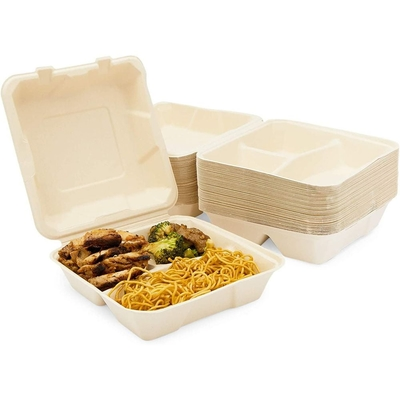
Cornstarch biodegradable plastic is a renewable plant-based material used in disposable lunch boxes. Designed as a direct alternative to petroleum plastics, it relies on plant starch to ensure safe direct food contact while naturally degrading after disposal to significantly reduce environmental pollution.
Engineering Renewable Packaging Solutions
Eco-friendly tableware manufacturers have accumulated significant R&D experience in developing biodegradable plant-based materials. Products utilizing this technology rely heavily on renewable plant starch as their primary raw material.
Multi-Angle Analysis:
- Theoretical Basis: Starch polymers are naturally occurring and break down rapidly under microbial action. Corn-starch tableware typically contains a high starch content (above 40%) to ensure it degrades naturally.
- Design Trade-offs: Pure starch is hydrophilic (water-soluble); thus, it must be expertly complexed with other polymers to achieve the waterproof and oil-proof properties required for commercial food transport.
- Practical Impacts: These eco-friendly lunch boxes degrade naturally after disposal—often within 180 days —turning into harmless substances. This aligns perfectly with corporate zero-pollution goals without sacrificing the functionality required by restaurants and takeaway businesses.
Practical Advice: Verify the starch content of your eco-friendly containers. A content level around 60% ensures the optimal balance between rapid biodegradability and necessary mechanical strength.
5. What Is the Role of PLA and PP Blends in Eco-Friendly Boxes?
Achieving the perfect balance between biodegradability and commercial durability requires precise composite engineering. Pure starch alone cannot meet the demanding physical requirements of the global catering industry.
Biodegradable lunch boxes made from corn-starch materials actively include small amounts of PLA or PP blends. This specific plastic used in disposable lunch boxes dramatically improves structural strength, water resistance, and heat tolerance while maintaining the compostable or eco-friendly properties of the container.
Formulating the Optimal Bio-Composite
To match the structural performance of traditional PP without violating green market policies, advanced bio-composite engineering is required. Hfenggreen utilizes a proprietary formulation combining a 60% non-GMO cornstarch base with 40% certified food-grade eco-polymers (modified PP/PLA matrix). This specific blend creates a heavy-duty polymer skeleton, preventing the container from becoming soggy or losing structural tension when holding boiling oils or acidic sauces. The result is a 100% waterproof and oil-proof container that achieves full FDA compliance while meeting international compostability standards.
| Component Substrate | Sourcing Ratio | Technical Function in Food Service |
| Industrial Non-GMO Cornstarch | 60% | Maximizes renewable resource base, ensures 180-day biodegradability, and eliminates chemical odors. |
| Modified Eco-Polymers (PP/PLA) | 40% | Delivers absolute leak-proofing, drop-test kinetic durability, and unlocks the 125°C thermal threshold. |
6. How Do Container Sizes Impact Material Selection?
The physical dimensions and intended volume of a takeaway container directly dictate the necessary tensile strength of the selected polymer blend, directly influencing the manufacturing injection molding parameters.
When molding the plastic used in disposable lunch boxes into large formats like 1200 ml, 1800 ml, or 2000 ml food containers, manufacturers must utilize highly durable plant-based starch composites. These specific blends ensure large containers remain lightweight, microwave-safe, and structurally rigid under heavy food loads.
Sizing and Structural Integrity
A practical example is the production of cornstarch biodegradable lunch boxes used in takeaway packaging that are molded into different sizes and compartments, such as 1200 ml, 1800 ml, or 2000 ml food containers. A 2000 ml container holding family-style portions undergoes significantly more mechanical stress than a small 500 ml side-dish box.
Multi-Angle Analysis:
- Theoretical Basis: Larger surface areas are far more prone to warpage during the cooling phase of injection molding. The material’s flow rate and tensile strength must be precisely calibrated to fill large molds evenly.
- Design Trade-offs: Thicker walls prevent bending in large 1800 ml boxes but increase the unit weight and raw material cost. Optimal material blending with PP/PLA maintains lightweight properties without sacrificing rigidity.
- Practical Impacts: The resulting products are lightweight, microwave-safe, and designed to degrade after disposal. Restaurants can confidently serve heavy, large-format meals without fearing the box will collapse or leak during delivery, making it a highly popular alternative to conventional plastic food containers.
Practical Advice: When ordering large capacity boxes (1500 ml+), request samples and perform a physical drop test while the container is filled with hot water to ensure the composite blend can handle the kinetic shock.
Conclusion: Upgrading Your Supply Chain to Compliant Cornstarch Packaging
Understanding what plastic is used in disposable lunch boxes is the first critical step to shielding your business from shifting plastic-ban regulations and rising carbon taxes. Relying on traditional pure PP and brittle PS is rapidly becoming a long-term operational liability for food distributors and restaurant chains.
Transitioning to Hfenggreen’s engineered 60% cornstarch containers allows your brand to match traditional thermal durability and drop-test rigidity while easily hitting corporate ESG targets. By sourcing directly from our China production facility, you secure maximum bottom-line margins and bypass intermediary markups.
📦 Don’t let single-use plastic penalties squeeze your wholesale margins. [Click Here to Source Direct: Request Your Free Cornstarch Meal Box Samples & 2026 Bulk Wholesale Price List Today!]
Frequently Asked Questions (FAQs)
1. What plastic is used in disposable lunch boxes today?
Historically, manufacturers rely on Polypropylene (PP) for hot foods and Polystyrene (PS) for cold foods. However, modern eco-friendly alternatives use cornstarch biodegradable plastics blended with small amounts of PLA or PP.
2. Why is Polypropylene (PP) so common in takeaway packaging?
PP is a heat-resistant plastic that easily maintains its structural integrity at high temperatures, making it the standard choice for microwave-safe lunch boxes and hot food delivery.
3. Are cornstarch biodegradable lunch boxes safe for microwaves? Yes. Advanced cornstarch composites are designed to be highly stable at high temperatures, operating safely within a temperature range from -5℃ to 125℃.
4. How long does it take for cornstarch materials to degrade? When disposed of properly, these biodegradable materials take approximately 180 days to break down completely.
5. What is the typical starch content in these eco-friendly boxes? Our products are made from a blend where corn starch accounts for 60% of the composition, ensuring both biodegradability and structural strength.
6. Can biodegradable containers hold liquids without leaking? Yes. The specific manufacturing formulation ensures that our products are completely waterproof, oil-proof, and stable, preventing any leakage during transport.