Sourcing reliable, heat-resistant packaging is no longer just an environmental initiative—it is a strict technical requirement for food safety and operational excellence. This guide clarifies the thermal limits of popular bio-materials, helping procurement teams avoid the disastrous “meltdown” risks associated with microwaving substandard takeaway containers.
Focusing on microwave safe cornstarch soup bowls is not just an environmental choice—it is a technical requirement for food safety and operational excellence. This guide clarifies the thermal limits of bio-materials to help you avoid the “meltdown” risks associated with takeaway packaging.
1. Clearing the “Biodegradable” Confusion: PLA vs. Cornstarch
There is a significant technical divide between different types of bioplastics. Many restaurant operators mistakenly believe that if a container is labeled “biodegradable,” it can automatically withstand microwave heating.
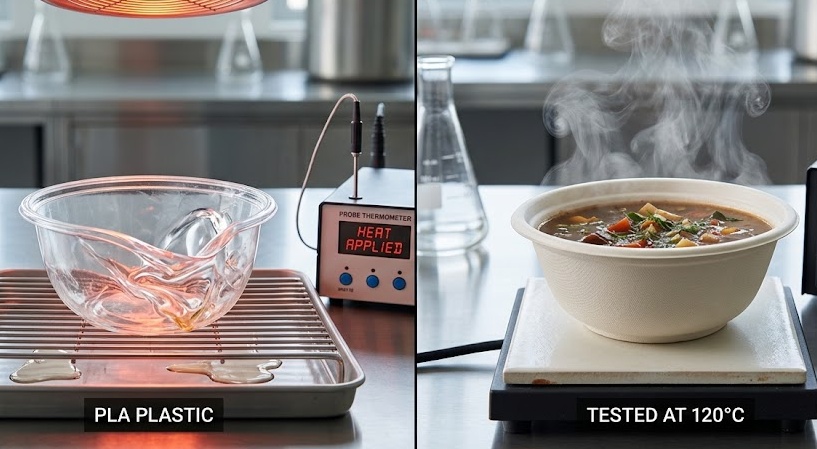
The PLA Limitation: Pure Polylactic Acid (PLA) is a popular bioplastic derived from plant sugars, but it has a low glass transition temperature (softening point) typically between 50°C and 60°C. If used for hot broth delivery or even short-duration microwave reheating, PLA containers will suffer from severe curling, melting, and structural failure.
The Cornstarch (PSM) Advantage: In contrast, the cornstarch packaging (Plant Starch Material) produced by Hfenggreen utilizes modified bio-based composites specifically engineered for “hot food scenarios.” Experience proves that for brands requiring secondary heating—such as healthy meal prep or Chinese fast food—selecting heat-resistant cornstarch bowls is the core strategy for eliminating “melted packaging” complaints.
2. 120°C: The Critical Standard for Microwave Safety
To ensure consumer safety, a container must do more than just hold its shape; it must remain chemically inert. Based on Hfenggreen’s technical specifications and industrial stress tests, the following data points establish the baseline for true microwave safety:
- Thermal Range: Our products are verified to operate safely between -20°C and 120°C (248°F). This standard far exceeds standard takeaway plastics, allowing the bowl to handle the concentrated heat generated by a high-power microwave.
- Material Density: Composed of over 70% renewable, non-GMO cornstarch, the high-density molecular structure ensures the bowl does not release BPA, phthalates, or other harmful chemical residues into the food.
- Structural Retention: After 3–5 minutes of continuous heating in a 120°C simulated microwave environment, these bowls maintain a structural rigidity rate of over 95%, with zero softening, oil seepage, or collapse.
3. Comparative Performance: Bio-Material Safety Data
When making a procurement decision, data-driven comparisons are essential to justify the transition to food-grade cornstarch containers.
| Performance Metric | Pure PLA Bioplastic | Hfenggreen Cornstarch (PSM) |
| Max Safe Temp | ~60°C (140°F) | 120°C (248°F) |
| Microwave Compatibility | Not Recommended | High-Power Safe |
| Heat Deformation | High Risk (Melts/Curls) | Low Risk (Stays Rigid) |
| Chemical Migration | Potential Leaching at heat | Zero Migration / Food Grade |
| Ideal Application | Cold Salads, Iced Drinks | Hot Soups, Ramen, Reheating |
Beyond temperature limits, buyers must also consider how these materials interact with moisture over long periods. For a deeper technical dive into sizing, manufacturing precision, and environmental conversion rates, you should refer to ourComplete Guide to Biodegradable Cornstarch Soup Bowls, which details how specific formulations achieve both high performance and 180-day compostability.
4. Solving the “Chemical Odor” and Migration Pain Point
A major hidden risk of inferior containers is the release of a pungent “plastic smell” during microwave heating. This odor is a clear signal of chemical migration, where residual monomers or additives are leaching into the food.
True microwave safe cornstarch soup bowls are inherently stable. Because the primary raw material is plant-based starch processed in sterile environments (ISO9001 compliant), the containers remain odorless even at peak temperatures. This ensures that the delicate flavors of your broth—whether it is a light Tom Yum or a rich bone marrow soup—remain untainted by synthetic aftertastes.
5. Engineering Reliability for Long-Distance Delivery
For delivery-centric businesses, the challenge isn’t just the microwave; it’s the steam pressure created during transit. Poorly designed lids often soften and lose their grip due to heat trapped inside.
When considering the structural integrity of your packaging, it’s worth noting how cornstarch bowls solve the “soggy lid” problem in long-distance delivery by using high-density composites that maintain their tension even in high-humidity environments. This ensures that the lid-matching precision—controlled to within 0.05mm in our factory—stays intact, allowing for a natural transition from the delivery bike to the customer’s microwave.
6. Case Study: Eliminating “Plastic Taste” Complaints in Meal Prep
Background: A B2B supplier specializing in healthy meal prep (Meal Prep) relied on a model where customers reheat meals in the office or at home.
The Pain Point: Their previous thin-walled plastic containers became dangerously hot to the touch after microwaving and often warped. Customers complained about a “plastic-like” taste and containers that collapsed under the weight of the soup, threatening the brand’s premium image.
The Solution: The supplier transitioned to Hfenggreen’s 460ml (HF-W06) and 800ml (HF-W07) cornstarch series.
Results:
- Safety Upgrade: Even with high-energy broths, the bowl remained rigid after 3 minutes in the microwave. The material’s natural insulation allowed customers to hold the bowl without burning their hands.
- Zero Odor Complaints: Post-transition, complaints regarding chemical smells disappeared entirely. Social media feedback shifted to praise for “premium, safe, and eco-friendly” packaging.
- Cost Efficiency: While the per-unit price was slightly higher than generic plastic, the stability allowed the company to remove expensive “outer cardboard sleeves.” This reduced total packaging system costs by 5% and contributed to an 18% increase in monthly subscription renewals.
7. Partnering for Thermal Excellence
As a manufacturer with a 350-ton monthly capacity, Hfenggreen ensures that every batch of cornstarch tableware meets international safety standards. If your restaurant or catering business is facing customer dissatisfaction due to warped or smelly packaging, it is time to upgrade to a scientifically verified solution.
Don’t let your packaging be the weak link in your food service. Contact Hfenggreen today for a consultation on microwave safety standards or to request samples of our heat-resistant cornstarch series.
Frequently Asked Questions (FAQs)
1. Is all biodegradable tableware microwave-safe?
No. Materials like pure PLA melt at low temperatures (~60°C). Only modified, heat-resistant materials like cornstarch (PSM) with a rating up to 120°C are safe for high-power microwave use.
2. How can I tell if a cornstarch bowl is high quality?
A high-quality bowl should be odorless, even when hot. It should maintain its rigidity after 3 minutes in a microwave and have a smooth, uniform finish without chemical residues.
3. Does the cornstarch release harmful chemicals when heated?
No. Our bowls contain over 70% renewable cornstarch and are free from BPA and phthalates, ensuring zero chemical migration during heating.
4. What is the maximum temperature Hfenggreen bowls can withstand?
They are tested for a working range of -20°C to 120°C (248°F), making them suitable for both the freezer and the microwave.
5. Why is the “plastic smell” dangerous in takeaway containers?
A plastic smell during heating indicates that volatile organic compounds (VOCs) or plasticizers are migrating from the container into your food, which is a significant health risk and ruins the food’s flavor.
6. Do these bowls require an outer sleeve for safety?
Because cornstarch composites have better thermal insulation than thin plastic, they are easier to handle after microwaving, often eliminating the need for extra cardboard sleeves.