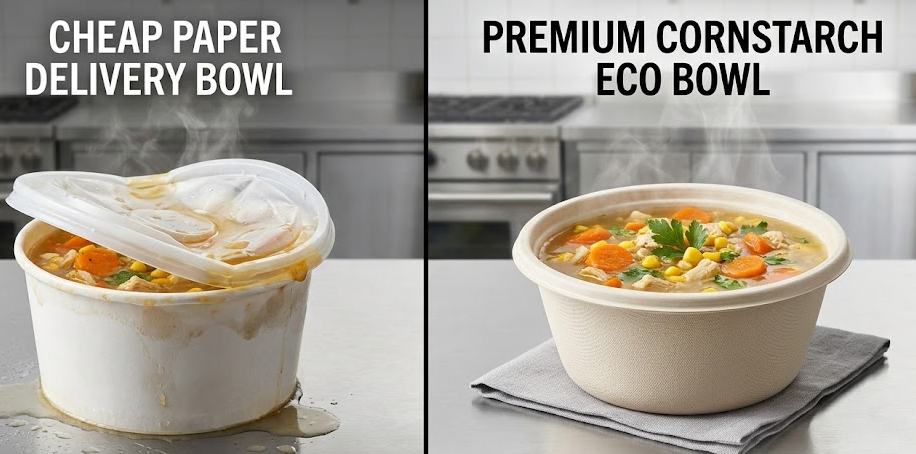
The “greenhouse effect” during long-distance delivery causes traditional packaging to absorb condensation, leading to collapsed lids and messy leaks. Ignoring this guarantees customer refunds and brand damage. Using high-polymer cornstarch bowls for food delivery locks in heat while maintaining rigid structural integrity, completely preventing soggy packaging failures.
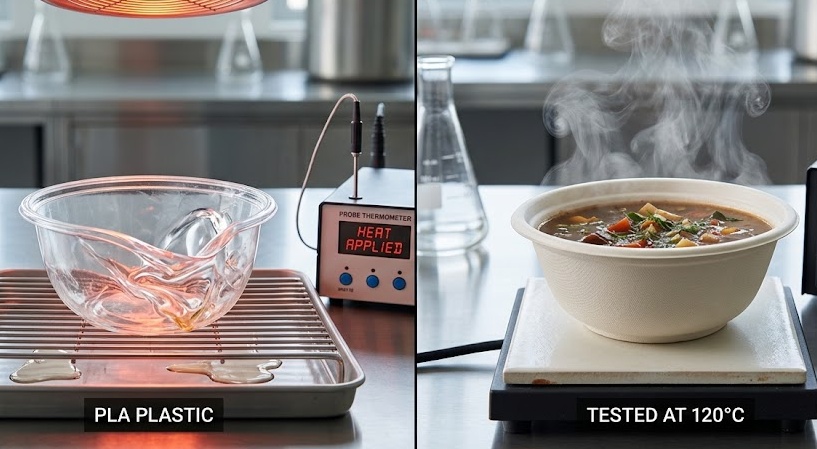
In the high-stakes food delivery market, the biggest challenge isn’t culinary preparation; it’s managing the “water vapor cycle” trapped inside the container. As the Chief Manufacturing Engineer at Dongguan Hengfeng High-Tech Development Co., Ltd., I see countless brands struggle with 30-to-50-minute transit times. Let’s break down the science of why traditional lids fail and how advanced cornstarch composites offer a definitive, leak-proof solution.
- Why Do Traditional Delivery Lids Fail?
- How Does Cornstarch Maintain Structural Integrity?
- What Are the Scientific Metrics Behind Leak-Proof Design?
- Case Study: Rescuing a Brand from a 3.2 Packaging Rating
- What Is the True Financial Impact of Upgrading Packaging?
- How Do Production Standards Ensure Consistency?
1. Why Do Traditional Delivery Lids Fail?
Understanding the mechanics of packaging failure is the first step to eliminating it. When exposed to hot liquids, conventional materials simply cannot handle the internal vapor pressure and extreme moisture.
Traditional lids fail because paper materials absorb condensation and lose tension, leading to structural collapse. Meanwhile, low-quality plastic lids expand under heat, creating gaps that allow liquids to spill. Neither material effectively manages the trapped 80°C steam generated during long-distance food delivery.
The “Greenhouse Effect” in Food Delivery
In food delivery, a sealed container holding hot soup at temperatures above 80°C acts as a miniature greenhouse. Steam rises, hits the cooler lid, and condenses.
- Failure Example 1 (Paper/Fiber): Standard paper lids or sugarcane bagasse materials are highly prone to absorbing this moisture. As the condensation soaks into the fibers, the lid loses its tensile strength, sagging directly into the food and compromising the anti-soggy food packaging requirement.
- Failure Example 2 (Low-Grade Plastic): Ordinary plastic lids, while waterproof, suffer from thermal expansion. The heat causes the rim to warp slightly, breaking the seal with the bowl. A slight bump during transit forces the liquid through these newly formed micro-gaps.
These structural failures dictate that procurement teams must look beyond cheap alternatives. For a broader overview of material options and engineering differences, exploring a Complete Guide to Biodegradable Cornstarch Soup Bowls provides essential context for establishing resilient supply chains.
2. How Does Cornstarch Maintain Structural Integrity?
To combat the destructive nature of trapped steam, the container material must possess inherent resistance to moisture absorption while maintaining thermal rigidity.
Cornstarch maintains structural integrity through its natural high-polymer properties, which resist moisture absorption and prevent softening. This advanced composite material acts as a rigid barrier, trapping heat effectively while ensuring the lid remains completely firm and unwarped throughout a 30-to-50-minute delivery cycle.
Polymer Stability Under Extreme Conditions
The structural secret lies in our unique formulation, which blends a cornstarch base with PPT plastic composites. Corn starch accounts for 60% of the composition , creating a highly durable, high-temperature resistant takeout bowl.
Unlike fiber-based materials that rely on woven physical bonds, the polymer structure of the cornstarch composite is fundamentally non-porous to water vapor.
- Thermal Deflection: The material refuses to warp under standard delivery heat.
- Low-Temperature Toughness: Its stability isn’t limited to heat; it performs exceptionally well down to -20°C. In cold-chain logistics or winter deliveries, the material does not become brittle or prone to cracking.
| Material Type | Moisture Resistance | High-Temp Rigidity | Low-Temp Toughness |
| Cornstarch Composite | Excellent (Non-porous) | High (Maintains shape) | High (Resists cracking) |
| Sugarcane Bagasse | Poor (Absorbs vapor) | Medium (Sags over time) | High |
| Standard PP Plastic | Excellent | Low (Prone to warping) | Medium |
3. What Are the Scientific Metrics Behind Leak-Proof Design?
Product design relies on rigorous testing and exact tolerances. We validate our leak-proof disposable soup bowls through strict laboratory metrics to guarantee reliable performance in real-world transit.
The scientific metrics behind our leak-proof design include a 120°C heat resistance peak and a precision-fit snap closure. During 60-minute simulated bump tests, uniform edge thickness and strict mold tolerances prevented 99% of liquid leakage, ensuring heavy liquid containment without structural deformation.
High-Temperature Resistance and Precision Tooling
While conventional hot soup is packed at 75°C to 90°C, our cornstarch composite is engineered to withstand a peak temperature of 120°C (248°F). This massive thermal buffer guarantees that the bowl and lid will not release toxic odors or warp, even under extreme conditions. For kitchens utilizing heavy reheating processes, consulting A Guide to PLA and Cornstarch Microwave Safety Standards for Restaurants ensures full operational compliance and safety.
Furthermore, our Precision-Fit Snap Closure dictates the leak-proof nature of the product. The lid and bowl are designed with interlocking micro-grooves.
- Application 1: In our high-capacity 800ml (HF-W07) bowls, the weight of the liquid exerts significant kinetic force against the lid during a bumpy scooter ride. The snap closure evenly distributes this force along the rim, preventing blowouts.
- Application 2: The uniform wall thickness engineered by our 250-ton injection molding machines prevents weak spots that could buckle under pressure.
4. Case Study: Rescuing a Brand from a 3.2 Packaging Rating
Theoretical data must translate into operational success. Real-world applications demonstrate how upgrading packaging materials immediately resolves severe delivery complaints and recovers lost revenue.
A boutique porridge shop suffering a 3.2 packaging rating due to soggy, leaking lids switched to our 420ml and 460ml cornstarch bowls. After the transition, delivery structural integrity remained perfect over 45-minute routes, eliminating refund losses and boosting their platform satisfaction score to 4.9.
Reversing the 8-Kilometer Delivery Crisis
A boutique porridge shop located in a central business district specializes in high-density seafood porridge. Because their core corporate customers were located 5 to 8 kilometers away, delivery times frequently exceeded 40 minutes.
The Pain Point: Their standard takeout containers were failing. The dense steam from the boiling porridge soaked the lids, causing them to collapse. Side leaks were common, resulting in 30 to 50 refund requests per month and a dismal 3.2 out of 5 packaging rating on delivery apps.
The Solution: The shop transitioned to Hengfeng High-Tech’s dedicated cornstarch soup bowls—specifically the 420ml (HF-W10) and the 460ml (HF-W06) models.
The Results:
- Perfect Structural Integrity: Even after 45 minutes of transit, the cornstarch lids remained entirely rigid, solving the “soggy lid” crisis instantly.
- Zero Leaks: The precision-fit closure eradicated side leaks, dropping the 30-50 monthly refunds down to zero.
- Rating Reversal: Within two months, the shop’s packaging satisfaction score surged to 4.9.
5. What Is the True Financial Impact of Upgrading Packaging?
While premium materials have a slightly higher upfront unit price, the overall financial health of a restaurant improves when operational waste and customer refunds are eliminated.
The true financial impact of upgrading to cornstarch packaging is a net increase in profitability. By eliminating the high costs of food replacements, platform penalties for poor reviews, and delivery leak refunds, businesses significantly lower their total operational expenses despite the initial material investment.
Transitioning from Expense to Investment
Procurement must calculate the Total Cost of Ownership (TCO). In the porridge shop case study, the unit cost of the cornstarch bowls was marginally higher than their previous flimsy plastic containers. However, the shop manager reported an overall 8% increase in net monthly profit.
This financial gain was driven by two factors: the complete elimination of refund losses and a noticeable increase in repeat customer orders due to the improved, premium unboxing experience. To fully grasp this financial shift, reviewing a detailed cost analysis of using this product helps quantify the return on investment for high-volume food service operations.
6. How Do Production Standards Ensure Consistency?
Scalability without compromising quality is the ultimate goal for B2B procurement. Consistent manufacturing processes guarantee that every container performs exactly as tested.
Production standards ensure consistency through automated injection molding and strict ISO9001 quality control. With a 350-ton monthly capacity, every batch of bowls and lids matches perfectly, preventing the common issue of loose or overly tight lids that plague inconsistent mass-market suppliers.
Mass Production and Quality Control at Hengfeng
A common complaint with generic wholesale packaging is batch inconsistency—one month the lids snap on perfectly, and the next month they are dangerously loose.
At Hengfeng High-Tech, we operate a modern, 10,000-square-meter independent factory equipped with imported American high-temperature mixers and automated 250-ton injection molding machines.
- Capacity: Our mature management system yields a stable monthly production capacity of 350 tons.
- Quality Systems: Certified under the ISO9001 International Quality Management System and U.S. quality standards, we guarantee that the tolerances on the lid’s sealing ring remain identical across millions of units.
Frequently Asked Questions
1. What are the raw materials of your product? Our product is made from a blend of corn starch and plastic, with corn starch accounting for 60% of the composition.
2. How long does it take for the material to degrade? It takes approximately 180 days to degrade fully.
3. Can these bowls be put into a microwave oven or a freezer? Of course, no problem. The operating temperature range is from -5℃ to 125℃, ensuring safety in both environments.
4. What are the precautions to take when storing? Store the products in a cool and dry environment to maintain their structural integrity.
5. How long will it take to deliver an order? Mass production lead time is within 25 days after receiving the deposit, while samples are typically delivered in 7-10 days.