Relying on substandard plastic packaging for institutional catering exposes students to chemical leaching and causes severe operational bottlenecks through transit leaks and structural failures. To choose safe disposable lunch boxes, institutions must strictly prioritize food-grade, non-toxic compostable materials like corn starch, select precise multi-compartment designs for nutritional separation, and secure a factory-direct manufacturer capable of stable bulk supply.
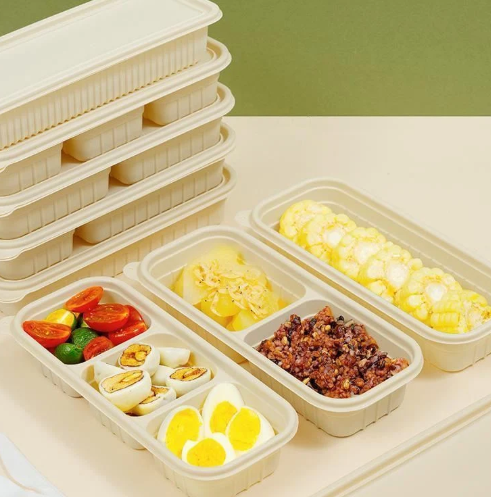
Table of Contents
- Prioritize Food-Contact Safety and Non-Toxic Materials
- Determine Capacity Requirements for Different Student Demographics
- Select Compartment Designs for Balanced Institutional Nutrition
- Evaluate Leak Resistance and Thermal Performance for Transit
- Assess Bulk Packaging and Large-Scale Supply Capabilities
- Align Packaging Procurement with Institutional Sustainability Goals
- Partner with Hfenggreen for Custom Institutional Food Packaging
1. Prioritize Food-Contact Safety and Non-Toxic Materials
The foundational requirement for any school cafeteria or corporate canteen is absolute biological and chemical safety. When serving thousands of meals daily to children and employees, there is zero margin for error regarding material toxicity.
A safe disposable lunch box must be manufactured from certified food-grade, non-toxic, and odor-free materials, ensuring that no harmful chemicals leach into the food under high temperatures during daily institutional catering.
The Risks of Traditional Plastics
Historically, traditional plastic lunch boxes were chosen for school meal containers purely due to their low cost and mature supply chain. However, petroleum-based plastics present hidden dangers. Under the stress of hot food, certain low-grade plastics can release harmful plasticizers or chemical odors. In an educational environment, especially primary schools, exposing children’s meals to these materials is an unacceptable operational risk that can lead to severe health liabilities and public relations crises for meal delivery service providers.
Plant-Based Bio-Composites
The modern standard for safe institutional food packaging is the utilization of advanced bio-composites. Biodegradable lunch boxes made from non-GMO corn starch offer a naturally safe food contact capability. Because the base material is derived from renewable plant sources rather than petrochemicals, it features a strictly non-toxic composition and an odor-free performance. This ensures that the natural flavor of the meal is preserved and that the packaging meets the strictest international food-safety compliance standards required by government catering contractors.
2. Determine Capacity Requirements for Different Student Demographics
Institutions serve a vast array of demographics, from kindergarteners requiring small, carefully portioned meals to university students and factory workers needing substantial caloric intake. Utilizing a one-size-fits-all container leads to food waste or inadequate portions.
Institutions must match container capacity to specific demographics, utilizing small containers for children’s meals, medium capacities for standard student lunches, and large 1200ml containers for university cafeterias and corporate canteens.
Portion Control and Menu Planning
Purchasing departments must work closely with nutritionists to determine the exact volumetric requirements of their menus. If a meal delivery service provides a container that is too large for a primary school student, the food will shift during transit, resulting in a messy, unappetizing presentation. Conversely, serving an adult employee in a small container leads to overpacking, which prevents the lid from sealing and causes leaks. A reliable supplier provides a comprehensive range of capacities to solve this issue.
Institutional Capacity Selection Matrix
| Capacity Range | Target Demographic | Suitable Institutional Applications | Optimal Food Types |
| Small Capacity | Primary schools, kindergartens, children. | Smaller portions, balanced meal sets, easy carrying designs. | Snacks, desserts, side dishes, kid-sized mains. |
| Medium Capacity | High schools, standard employee lunches. | Standard student meal programs, office meal delivery. | Standard takeaway meals, rice bowls, pastas. |
| Large Capacity | Universities, factory workers, catering. | Campus restaurants, high-volume corporate canteens. | Large catering portions, combined meals, heavy entrees. |
For high-volume operations, large-capacity compostable containers—such as 1200ml corn starch lunch boxes—are essential. They allow university food services and corporate canteens to execute faster serving speeds during peak lunch hours while accommodating substantial meal portions.
3. Select Compartment Designs for Balanced Institutional Nutrition
School lunches and corporate meals are rarely single-item dishes. They typically consist of a main staple (rice or pasta), proteins, vegetables, and sauces. How these components are separated dictates the perceived quality of the meal.
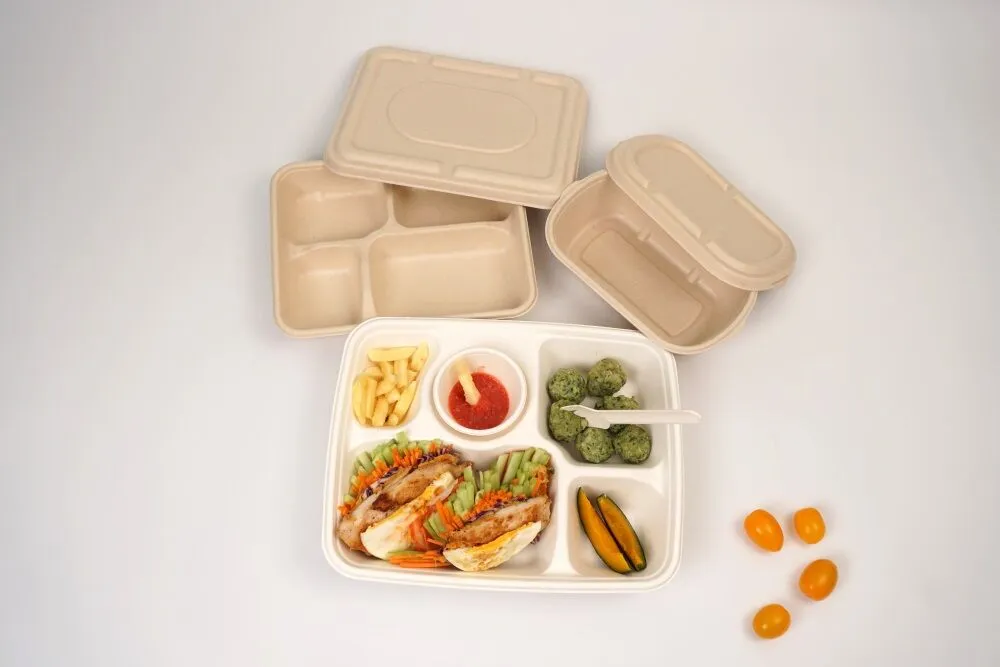
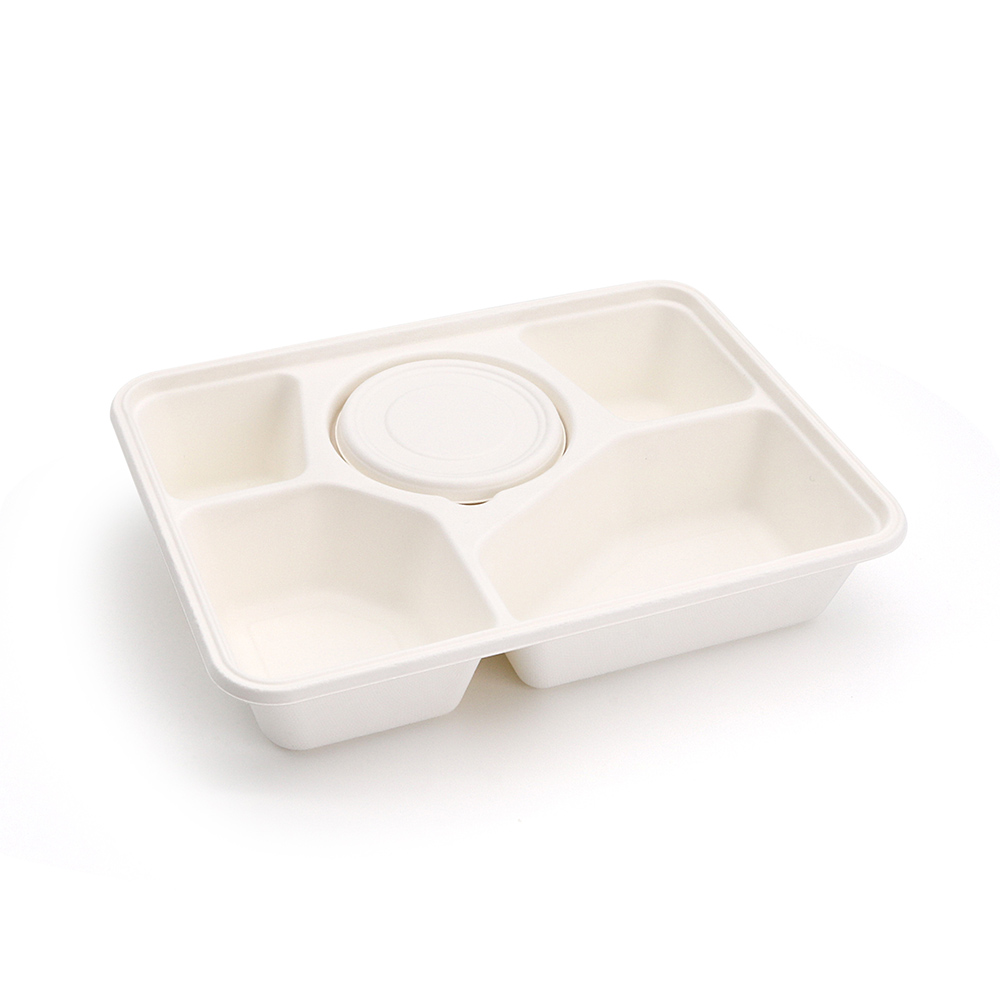
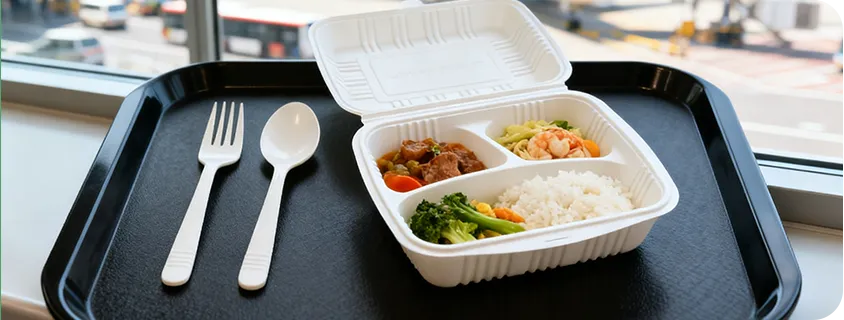
To maintain meal presentation and prevent food mixing, schools must select multi-compartment lunch boxes (2 to 4 sections) for balanced bento meals, while using single compartments for fast-serving, unified-meal environments.
Multi-Compartment Engineering for Nutritional Separation
For school meal delivery programs focusing on nutrition, portion control and separation are paramount. Multi-compartment lunch boxes feature rigid internal dividers that isolate different food items. This prevents wet items, like fruit or curry, from turning dry items, like rice or fried chicken, into a soggy mess. By preventing food mixing, multi-compartment containers maintain the chef’s intended flavor profile and vastly improve the visual presentation of bento meals, which is crucial for student satisfaction and parent approval in school lunch programs.
Single Compartment Efficiency
In scenarios where the menu consists of unified dishes—such as a large serving of pasta or a single rice bowl—single compartment lunch boxes are the optimal choice. They offer the highest capacity utilization and lower packaging costs. In fast serving environments like a busy university cafeteria, single compartments are easier to store, faster to fill on the prep line, and simpler to stack, streamlining the entire meal distribution process.
4. Evaluate Leak Resistance and Thermal Performance for Transit
Institutional catering often involves a central kitchen model where meals are prepared in bulk and transported to satellite campuses or office buildings. The packaging must withstand significant logistical stress.
Institutional food packaging must provide exceptional leak resistance to secure saucy dishes during transit, alongside high heat resistance to withstand hot meals, temperature changes, and potential microwave reheating requirements.
Structural Integrity and Leak Prevention
When transporting hundreds of meals in delivery vans, the containers are subjected to constant vibration and lateral movement. If a container holding curry dishes, pasta, or mixed meals lacks a secure lid seal, it will result in sauce leakage. This not only causes food contamination between stacked boxes but also creates severe cleaning difficulties for institutional staff. High-quality eco-friendly food containers utilize precision-molded snap-fit lids that create a tight mechanical lock, ensuring that the meals arrive at the school or corporate canteen in pristine condition.
Thermal Deflection and Barrier Properties
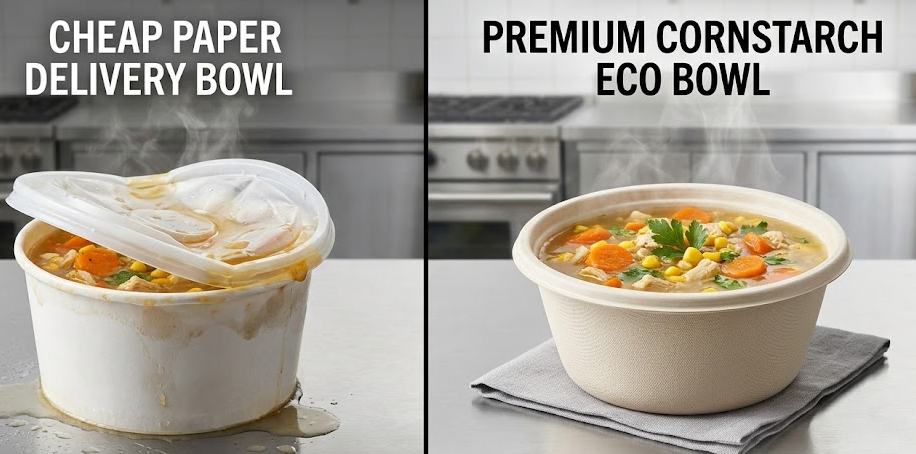
School and institutional meals are often packed piping hot to ensure food safety standards are met upon delivery. The packaging must possess extreme heat resistance. Low-grade materials will warp, soften, or melt. Professional corn starch lunch boxes are engineered for exceptional thermal stability, safely holding hot meals without deformation. Furthermore, they feature inherent waterproof and oil-proof properties, preventing greasy or liquid-heavy foods from penetrating the container walls, which is a common failure point in standard paper-based packaging. They also support cold and freezing environments, allowing for flexible advanced meal preparation.
5. Assess Bulk Packaging and Large-Scale Supply Capabilities
Procurement for large-scale food service is entirely different from buying for a single restaurant. Institutions require thousands of units daily, making supply chain stability as critical as the product itself.
Purchasing departments must partner with a factory-direct manufacturer offering high carton packing efficiency, stable production schedules, and massive output capacity (exceeding 300 tons/month) to guarantee supply consistency.
Factory-Direct Supply Chain Reliability
A sudden shortage of wholesale lunch boxes for school cafeterias immediately paralyzes the institution’s ability to feed its students. Relying on trading companies introduces severe risks regarding inventory management and delayed delivery schedules. A factory-direct manufacturer eliminates these bottlenecks. By controlling the entire production process, a direct supplier can guarantee a stable production schedule, ensuring that long-term supply relationships are honored without interruption.
Warehousing and Logistical Efficiency
For corporate cafeterias and government catering contractors, warehouse storage space is highly valuable. The physical design of the disposable lunch boxes wholesale must support optimal carton packing efficiency. Containers and lids must nest tightly to minimize the volumetric footprint during shipping and storage. An efficient packing configuration reduces freight costs, lowers storage overhead, and ensures that the maximum number of units can be kept on hand at the institutional facility.
6. Align Packaging Procurement with Institutional Sustainability Goals
Educational institutions and government bodies are under immense public and regulatory pressure to eliminate single-use plastics and adopt sustainable procurement practices.
Transitioning to biodegradable lunch boxes helps institutions eliminate single-use plastic waste, meet strict environmental compliance standards, and establish a sustainable, eco-friendly public image that aligns with institutional ESG goals.
Reducing Petrochemical Dependence
By adopting compostable meal containers for large-scale food service, schools directly reduce their plastic waste output. Traditional plastics sit in local landfills for centuries, a reality that contradicts the educational values taught in modern classrooms. Biodegradable lunch boxes, specifically those formulated from plant-based corn starch, offer an environmentally responsible alternative.
Building a Green Institutional Image
For corporate canteens and universities, demonstrating environmental responsibility is a key component of their corporate image. Sustainable company image initiatives are heavily bolstered by visible changes, such as upgrading cafeteria packaging. Utilizing eco-friendly food containers not only satisfies strict procurement standards and local environmental regulations but also communicates a clear message of sustainability to students, employees, and the broader community.
7. Partner with Hfenggreen for Custom Institutional Food Packaging
Finding a supplier that simultaneously delivers certified food safety, massive manufacturing scale, and deep product customization is the primary challenge for institutional procurement teams. Hfenggreen resolves this challenge through advanced manufacturing infrastructure.
Hfenggreen is a premier factory-direct manufacturer providing schools and institutions with non-toxic, compostable corn starch lunch boxes, offering extensive OEM customization and a massive 350-ton monthly bulk supply capability.
Comprehensive Solutions for Diverse Meals
Hfenggreen understands that institutional catering requires a versatile product range. We provide a complete packaging solution that eliminates the need for organizations to manage multiple vendors. Our product line features different sizes—from small snack containers for primary schools to large 1200ml capacities for corporate dining—alongside diverse compartment options (1 to 4+ sections) to accommodate any balanced meal requirement. Engineered for heavy-duty transit, our containers offer supreme leak resistance, oil resistance, and heat stability.
OEM Customization and Unmatched Scale
Operating from an independent production facility exceeding 10,000 square meters, Hfenggreen guarantees the large-scale supply capability required by government contractors and meal delivery service providers. With a stable output of up to 350 tons per month, we support the highest-volume daily meal distributions without stockouts. Furthermore, our deep OEM customization services allow institutions to dictate custom sizes, precise compartment layouts for portion control, and custom logo integration to reinforce their sustainable branding.
Conclusion
Choosing the right disposable lunch boxes for daily institutional meals requires a rigorous evaluation of safety, performance, and supply chain reliability. By prioritizing food-grade, non-toxic corn starch materials, institutions can protect student health while drastically reducing plastic waste. Selecting the correct volumetric capacity and multi-compartment designs ensures proper portion control and meal presentation. Ultimately, partnering with a factory-direct manufacturer capable of massive bulk production guarantees that high-volume school cafeterias and corporate canteens operate seamlessly and sustainably every single day.
Hfenggreen provides safe and sustainable biodegradable lunch boxes for schools, institutions, and large-scale catering services. With multiple sizes, compartment designs, OEM customization, and reliable bulk supply capability, we help organizations upgrade their daily meal packaging solutions. Contact us today to discuss your packaging requirements and get a customized solution for your organization.
FAQ
What makes corn starch lunch boxes safe for school cafeterias?
Corn starch lunch boxes are manufactured from renewable, plant-based materials that are strictly food-grade and non-toxic. Unlike some low-grade plastics, they are odor-free and do not leach harmful chemicals or microplastics into the food, ensuring maximum safety for daily student meals.
How do multi-compartment containers improve institutional catering?
Multi-compartment designs feature rigid internal walls that separate staples, proteins, and sauces. This prevents food mixing during rough transportation, maintains strict nutritional portion control, and preserves the culinary presentation of the meal, which is highly important for student and employee satisfaction.
Can these biodegradable lunch boxes handle hot meals and microwave reheating?
Yes. High-quality corn starch containers offer excellent heat resistance. They maintain their structural integrity when filled with steaming hot meals in the central kitchen, withstand the temperature changes during transit, and are fully safe for microwave reheating by the end consumer.
How does Hfenggreen ensure consistent bulk supply for large school districts?
Hfenggreen operates as a direct manufacturer with a production facility exceeding 10,000 square meters. Our highly automated lines provide a stable production capacity of up to 350 tons per month, guaranteeing that massive daily orders from schools and institutional food suppliers are fulfilled without delay.
Do you offer custom container sizes and logo printing for universities?
Absolutely. We provide comprehensive OEM customization for institutional clients. This includes the development of custom molds for specific sizes or unique compartment layouts, as well as custom logo integration to align with your university or corporate brand’s sustainability initiatives.
Are corn starch food containers resistant to leaks and oily foods?
Yes, our compostable food containers are engineered with a high-density structure that provides inherent waterproof and oil-proof performance. Combined with precision snap-fit lids, they securely hold heavy curries, pastas, and mixed meals without leaking during high-volume delivery.