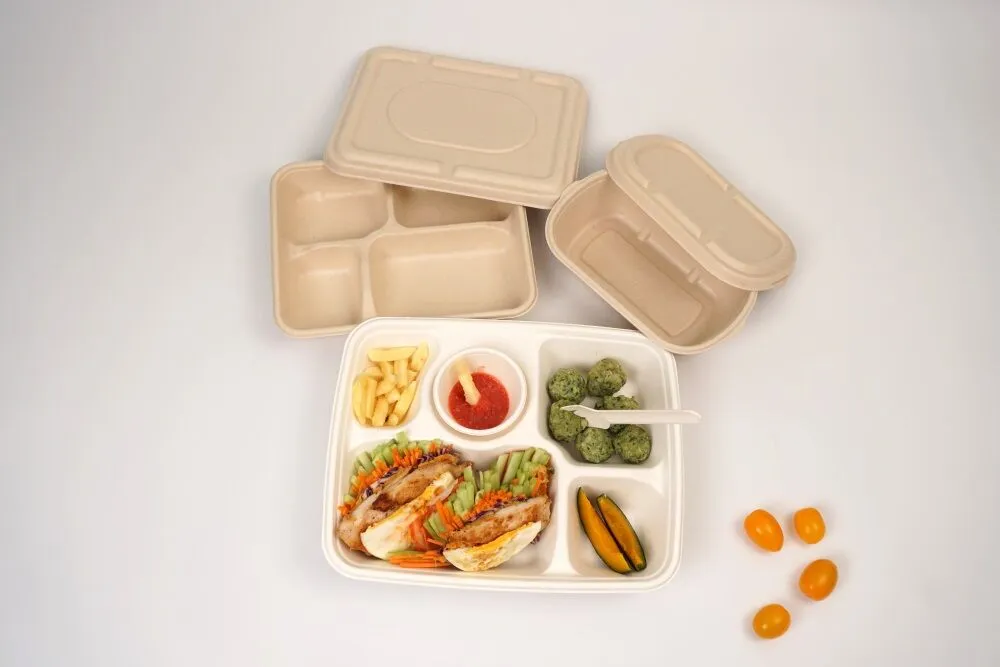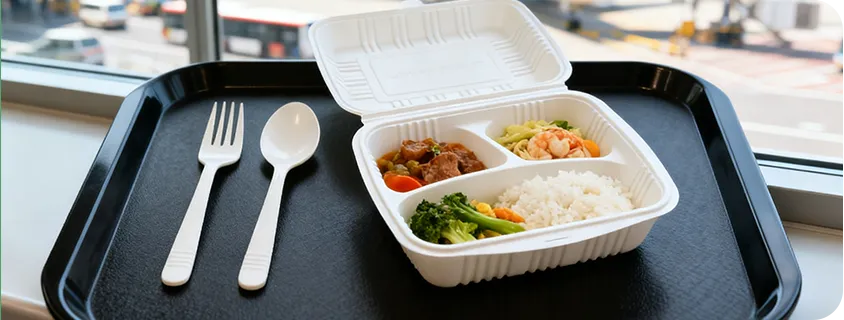
Spills during transit ruin food presentation and trigger costly operational refunds. Simply adding a cover does not guarantee containment; true leak resistance requires precise snap-on lid fits, high material rigidity, and engineered edge-sealing structures designed for specific food viscosities.
As the Chief Manufacturing Engineer at Dongguan Hengfeng High-Tech Development Co., Ltd., I spend my days analyzing container failure points under real-world logistical stress. When a delivery vehicle navigates a sharp turn or brakes suddenly, the kinetic energy transferred to the packaging is immense. Let us break down the exact engineering mechanics behind genuine leak resistance to help your procurement team source structural packaging that actually performs under pressure.
Table of Contents
- Why Is Lid Fit Precision the Core of a Leak Proof Food Tray?
- How Does Material Rigidity Impact Spill Proof Disposable Trays?
- Does Food Viscosity Determine the Packaging Leak Risk?
- What Are the Financial Impacts of Transport Spills?
- How to Select Reliable Catering Trays With Lids Wholesale?
1. Why Is Lid Fit Precision the Core of a Leak Proof Food Tray?
Procurement teams often assume any covered container inherently secures food. This critical misconception ignores the harsh dynamics of vehicular transit, where continuous vibrations quickly expose structural flaws in generic tray designs.
A lid only prevents spills if the tray edge sealing design utilizes a precise snap-on mechanism. Without this physical locking interference, standard covering lids will shift under transit pressure, causing significant fluid leaks regardless of how tightly they initially appear to sit.
1.1 The Mechanics of Structural Interference and Sealing
The theoretical basis for leak proof food trays relies entirely on structural interference—the engineered physical resistance between the tray’s outer rim and the lid’s internal locking groove. In injection molding, achieving a watertight seal requires maintaining dimensional tolerances down to the micrometer. If the mold is imprecise, the plastic will warp upon cooling, leading to micro-gaps that allow fluids to escape. Designers must balance this tightness; a seal that is too secure becomes a frustration for the end-user attempting to open their meal.
Consider two distinct applications. For Indian takeaway curries, which are highly fluid and prone to staining, we engineer a deep flange lock that clicks audibly, ensuring the lid cannot be dislodged by lateral movement. Conversely, for corporate salad delivery trays, a simple snap-fit anti-fog PET lid is sufficient, as the primary goal is visual presentation and keeping the greens crisp rather than containing heavy liquids.
When sourcing catering trays with lids wholesale, your quality assurance team should implement standardized physical evaluations before placing bulk orders.
| Evaluation Metric | Testing Protocol | Target Result |
| Mechanical Engagement | Apply downward pressure along the rim | Audible “snap” confirming a locked state |
| Lateral Resistance | Push horizontally against the sealed lid | Zero lateral shifting or popping |
| Drop Test | Drop a water-filled tray from 3 feet | Seal remains intact; no structural failure |
Practical Advice for Procurement: Always request custom samples before mass production. Fill the sample with water, seal it, and invert it over a dry paper towel for 60 seconds to immediately identify micro-fissures in the sealing geometry.
2. How Does Material Rigidity Impact Spill Proof Disposable Trays?
Material selection dictates exactly how a tray base behaves under mechanical stress. A flexible substrate will warp and compromise the seal, while a rigid base maintains the necessary locking friction.
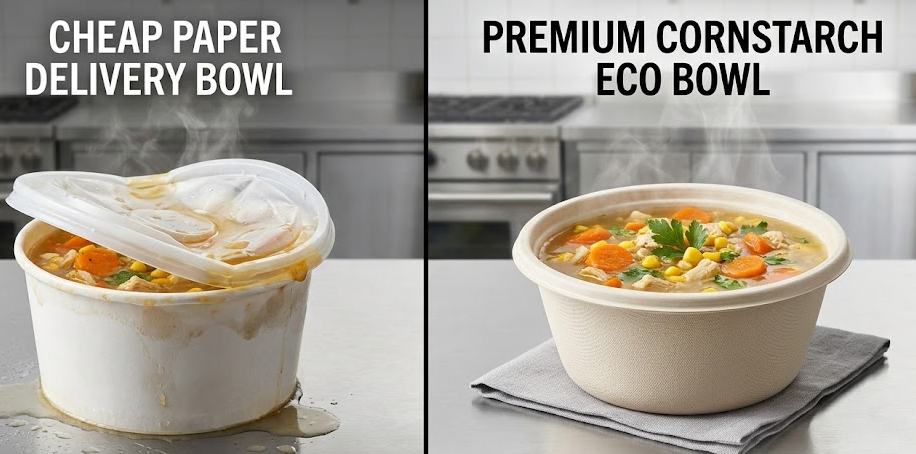
High material rigidity directly reduces spill risks by preventing structural deformation under stacking pressure. When the tray walls remain perfectly stiff, the snap-on lid maintains its strict locking tolerance, ensuring the engineered seal remains intact during high-movement delivery and logistical scenarios.
2.1 Evaluating Cornstarch Composites Against Traditional Polymers
To design highly effective spill proof disposable trays, material engineers must evaluate the flexural modulus—the measure of a material’s stiffness. Traditional pure bagasse (sugarcane pulp) provides adequate rigidity but absorbs moisture over time, eventually softening and causing the lid to loosen. Standard PP (polypropylene) is highly flexible; under heavy stacking weight, the side walls bow outward, which actively forces the lid to pop off.
At Hengfeng High-Tech, we solve this structural compromise through an innovative composite formulation that combines a renewable cornstarch base with PPT plastics (accounting for a 60% cornstarch composition). This exact blending ratio provides the high-temperature stability of plastic with the rigidity of compressed starch. For example, when packaging a hot roasted Thanksgiving turkey, the intense heat will not warp our composite tray; the walls remain rigid, preserving the lid’s tight seal. Similarly, for frozen ready-meal logistics, the material maintains its impact resistance, functioning flawlessly within an operating temperature range of -5℃ to 125℃ without turning brittle and cracking.
Understanding material behavior under thermal load is critical for product designers selecting eco friendly trays with lids.
- Thermal Expansion Control: The base material and lid must expand and contract at similar rates to prevent seal separation during microwave reheating.
- Compression Strength: The tray must support the vertical load of at least four stacked identical meals without deflecting more than 2mm.
- Oil and Water Resistance: The substrate cannot rely solely on a sprayed-on coating; the material itself must be inherently non-porous.
Testing Method: Place a 5kg weight on top of your current sealed tray for 30 minutes at room temperature. If the side walls buckle or the lid pops, the material rigidity is insufficient for standard commercial transit.
3. Does Food Viscosity Determine the Packaging Leak Risk?
Not all menus require the same containment engineering. Viscosity and temperature dictate necessary tolerance levels, requiring procurement managers to match packaging structural designs directly to their specific culinary applications.
Food viscosity and temperature act as the primary variables determining transit spill risk. While dry foods pose almost zero leak risk, hot liquids require advanced edge-sealing structures and highly rigid designs to actively prevent capillary action and pressure-induced fluid leaks.
3.1 Engineering Containment Forces for Diverse Menus
A foundational rule in packaging physics is that the container’s sealing force must consistently exceed the internal hydrostatic and vapor pressure exerted by the payload. “Leak-resistant” is not a universal guarantee; it is a measure of precise scenario-matching capability.
Packaging dry items like fried chicken or french fries presents virtually zero leakage risk. In fact, an airtight seal here is detrimental, as trapped steam will ruin the breading; these applications require engineered ventilation ports. On the other hand, delivering thin, hot liquids like Tonkotsu ramen broth or heavy stews introduces extreme variables. The heat generates steam, rapidly increasing the internal vapor pressure. If the disposable food trays with lids for takeaway lack a reinforced double-locking rim, this pressure will actively force the liquid up the side walls and through microscopic fissures via capillary action.
When configuring your custom mold forming requirements with a manufacturing partner, classify your menu items to dictate the necessary tooling.
| Payload Category | Internal Pressure Variables | Recommended Structural Tooling |
| Dry / Fried Foods | High steam, low hydrostatic pressure | Vented lids, standard rigidity base |
| Semi-Liquids (Pasta) | Low steam, moderate lateral slosh | Standard snap-fit, deep compartment walls |
| Hot Liquids (Soups) | High steam, high hydrostatic pressure | Double-locking rim, pressure-release micro-valve |
Practical Advice for Designers: Conduct a dynamic 45-degree tilt test. Heat your specific menu item to its absolute maximum serving temperature, seal it in the prototype tray, and angle it at 45 degrees for five minutes. If condensation or liquid breaches the outer rim, you must upgrade to a more aggressive structural interference mold.
4. What Are the Financial Impacts of Transport Spills?
Leaking containers directly erode operational margins. Beyond the immediate waste of food, secondary costs associated with poor packaging choices compound rapidly, significantly affecting delivery logistics, labor efficiency, and brand equity.
Transport spills severely impact profitability by triggering direct customer refunds, food remaking costs, and negative digital reviews. Investing in secure-lid tray systems significantly reduces delivery losses and customer complaints, effectively transforming engineered packaging from an operational expense into a margin-protecting asset.
4.1 Analyzing Delivery Losses and Structural Mitigation
From a B2B procurement perspective, transport stability directly equals supply chain cost control. When a restaurant purchases cheap, poorly engineered trays, the minimal initial unit savings are immediately wiped out by exponential failure rates in the field. The operational disruptions are severe and multi-layered.
Consider a fast-casual delivery scenario: a sharp turn causes a poorly fitted lid to dislodge, spilling hot curry inside an insulated delivery bag. The restaurant must completely refund the customer, pay the food and labor cost to remake the meal, and absorb the long-term damage to their digital reputation. In a central kitchen bulk delivery scenario, stacking 20 poorly designed trays can result in the bottom tiers collapsing under the weight, causing multiple lids to pop open and ruining the presentation for an entire high-value corporate event.
By switching to reliable OEM/ODM catering trays with optimized spill-proof lid designs, operators systematically mitigate these daily risks.
- Direct Financial Savings: Complete elimination of replacement food costs and delivery app penalty fees.
- Brand Protection: Ensuring customers receive food with intact presentation drives crucial repeat order volume.
- Operational Efficiency: Eliminates the kitchen labor wasted on double-wrapping weak containers in plastic film.
Practical Advice for Procurement: Track your current packaging failure rate over a 30-day period. Calculate the exact cost of heavy-duty replacement packaging against your monthly refund expenditures to prove the ROI of upgrading your tray systems.
5. How to Select Reliable Catering Trays With Lids Wholesale?
Sourcing reliable eco-friendly trays requires evaluating the manufacturer’s deep engineering capabilities. Buyers must look beyond unit price to carefully assess molding precision, material stability, and the factory’s actual customization capacity.
When sourcing disposable food trays with lids for takeaway, prioritize manufacturers offering complete OEM customization, automated high-tonnage injection molding, and proven international quality certifications. Partnering with a specialized factory ensures consistent, reliable spill-proof performance and exact structural tolerances across massive production volumes.
5.1 OEM Customization and Factory Level Solutions
For procurement managers, evaluating a supplier’s production environment is as critical as testing the final product prototype. A wholesale order’s ability to remain leak-resistant across thousands of units depends entirely on the precision of the manufacturing equipment and the stringency of the factory’s quality control protocols. Inconsistent molding temperatures or degraded tooling will instantly ruin the snap-fit tolerances discussed earlier.
At Hengfeng High-Tech, we operate a modern, 10,000-square-meter independent factory where all production occurs in a sterile, pollution-free environment. Our automated production lines feature imported American high-temperature mixers and heavy-duty 250-ton injection molding machines. For buyers requiring custom configurations, such as custom mold forming for specific compartment depths or sophisticated embossing craftsmanship for distinct brand visibility, we provide flexible OEM options. Our monthly production capacity reaches 350 tons, with a 25-day turnaround, backed by ISO9001 and U.S. quality certifications.
When finalizing supplier specifications, verify their output capacity limits and certification standards.
| Sourcing Criteria | Minimum Standard | Hengfeng High-Tech Benchmark |
| Customization Scope | Standard catalog sizes only | Full OEM/ODM mold forming & embossing |
| Injection Capacity | Manual/Semi-automated lines | 250-ton automated injection machines |
| Minimum Order Quantity | Full shipping containers | Starts at 100 boxes (500 units per box) |
Practical Advice for Buyers: Request a video tour of the supplier’s injection molding facility. Look for automated lines and sterile environments to ensure consistent quality control before signing a long-term supply contract.
Conclusion
Securing food during high-stress transit is an exact science dependent on micrometer lid tolerances, high-rigidity composite materials, and a deep understanding of food viscosity dynamics. By moving away from generic, flexible containers and upgrading to engineered cornstarch composite packaging, your B2B operation can systematically eliminate costly delivery failures while meeting strict global environmental standards.
At Dongguan Hengfeng High-Tech Development Co., Ltd., we operate automated 250-ton injection molding lines to guarantee ISO9001 and U.S. quality-certified precision across massive production volumes. If you are experiencing high failure rates with your current disposable tableware, contact our engineering team directly today to discuss custom mold forming, request rigorous material samples, or receive an immediate manufacturing quote for your specific application needs.
Frequently Asked Questions (FAQ)
1. What are the raw materials of your product? Our product is made from an innovative blend of corn starch and plastic, with corn starch accounting for 60% of the composite material composition.
2. Can your eco friendly trays with lids be put into a microwave oven or a freezer? Yes. Our composite material is highly stable, with a safe operating temperature range extending from -5°C to 125°C, making it perfectly safe for both microwaves and freezers.
3. How long does it take for the disposable catering trays to degrade? Our products are designed to be fully biodegradable. Under proper conditions, they take approximately 180 days to completely break down without leaving toxic residue.
4. What are the precautions to take when storing catering trays with lids wholesale? To preserve the structural integrity and longevity of the material, simply store the unopened boxes in a cool and dry environment.
5. How long will it take to deliver a bulk order? With our high-capacity automated production lines, mass production lead times are highly efficient, with delivery typically occurring within 25 days after receiving the initial deposit.
6. Do you offer customization for your disposable food trays with lids for takeaway? Absolutely. We provide extensive OEM/ODM customization services, including custom mold forming for unique compartment shapes and advanced embossing or relief craftsmanship for brand logos.
7. What is the minimum order quantity for custom orders? We accommodate businesses of multiple sizes. Our minimum order requirement starts at just 100 boxes, with each box containing 500 units.