Choosing a heavy-duty disposable tray requires evaluating structural rigidity, heat resistance, and load capacity rather than just material thickness. By selecting engineered composites with reinforced rims and compartmentalized designs, procurement teams prevent container collapse, eliminate fluid leaks, and reduce costly replacement orders.
On the production floor at Hengfeng High-Tech, our engineering team regularly reverse-engineers packaging failures from the catering and hot-food delivery sectors. A transit spill is rarely a random accident—it is a predictable mechanical failure. When a delivery vehicle brakes abruptly, the kinetic energy transferred to a stacked, 2-pound meal is severe. If the tray material lacks the appropriate flexural modulus, the side walls deflect outward, instantly breaking the lid’s micro-seal. Solving this requires moving beyond generic “thickness” metrics to evaluate fiber density, composite blending, and structural ribbing. Let’s break down the exact engineering variables needed to specify truly durable catering trays.
Table of Contents
- Why Is Structural Design More Critical Than Material Thickness?
- How Do Material Types Affect Load Capacity and Heat Resistance?
- What Are the Specific Requirements for Different Food Delivery Scenarios?
- How Does Stacking Stability Impact Catering Operations?
- Why Are Custom OEM Configurations Essential for High-Volume Buyers?
1. Why Is Structural Design More Critical Than Material Thickness?
Procurement teams often assume that increasing the thickness of a tray automatically makes it more durable. However, simply adding raw material weight does not solve mechanical failure points during commercial transport.
A heavy-duty disposable tray relies on engineered structural interference like reinforced rims, molded anti-slip channels, and compartmentalized support walls to distribute weight. These integrated features prevent bending and sagging under heavy loads far more effectively than merely increasing the base material thickness.
Engineering Mechanics Behind Tray Rigidity
When evaluating a heavy duty disposable tray, the physical geometry dictates how kinetic energy and static weight are absorbed. A thick, perfectly flat bottom is highly susceptible to warping under the weight of heavy, hot foods. Conversely, a carefully engineered tray uses specific molding techniques to create structural tension.
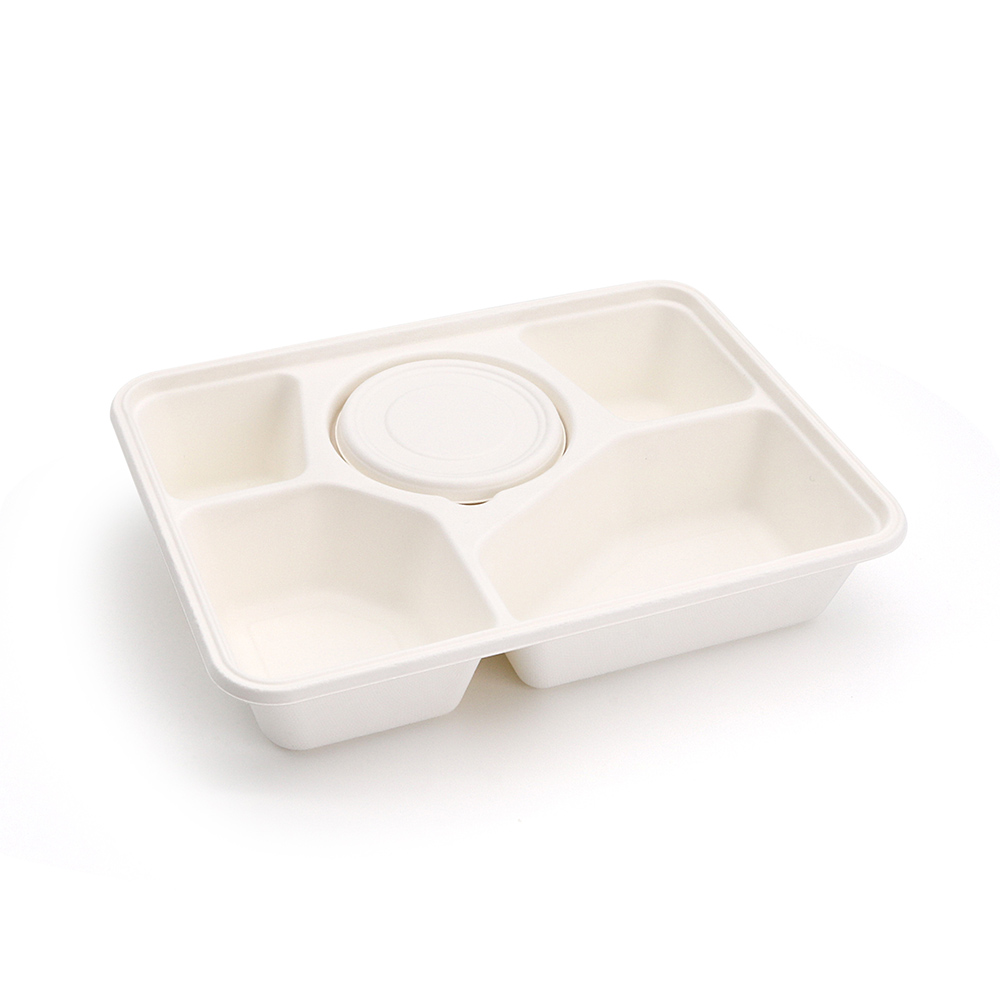
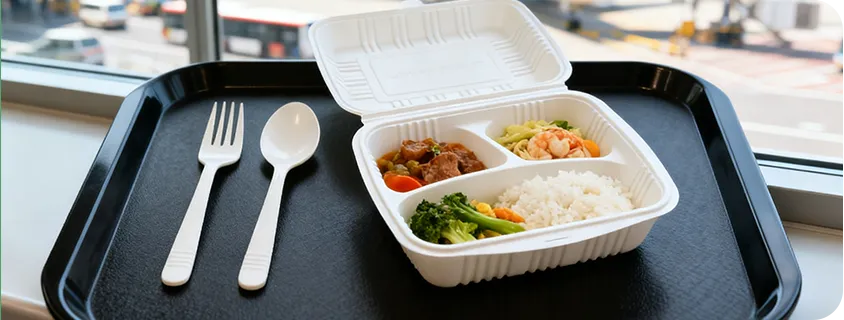
Consider two distinct application examples. First, serving a large portion of BBQ ribs requires a wide surface area. If the tray bottom is flat, the weight of the meat will cause the center to sag when carried with one hand. By incorporating molded anti-slip channels (ribbing) across the base, the tray gains immense flexural strength, resisting bending. Second, in hospital or school catering, carrying liquid-heavy side dishes alongside a main course requires compartmentalization. The vertical interior walls separating the compartments act as central load-bearing pillars, vastly increasing the overall rigidity of the unit.
From a design trade-off perspective, adding complex geometry requires more sophisticated injection molding or fiber pressing tools, but it ultimately saves on material costs because you do not need to over-extrude the base material to achieve strength.
| Structural Feature | Mechanical Benefit | Real-World Impact |
| Reinforced Rim | Resists lateral twisting | Prevents lids from popping off during transit |
| Molded Channels | Increases base flexural modulus | Stops bottom sagging under heavy main courses |
| Compartment Walls | Acts as internal support pillars | Prevents tray buckling when carried one-handed |
| Deep Tray Cavity | Lowers the center of gravity | Keeps sauces contained during sharp vehicle turns |
Practical Testing Advice: To test structural integrity, hold a fully loaded prototype tray by one corner. A well-engineered heavy duty disposable tray will remain rigid, while a poorly designed (even if thick) tray will buckle diagonally.
2. How Do Material Types Affect Load Capacity and Heat Resistance?
The base material dictates how a tray reacts to extreme temperatures and moisture. Selecting the wrong substrate leads to thermal warping, oil seepage, and sudden structural collapse in delivery bags.
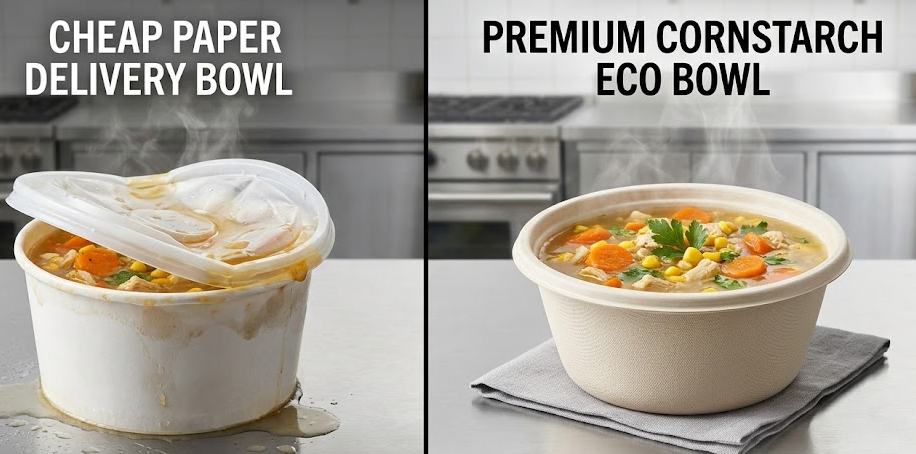
High-performance materials like engineered cornstarch composites and compressed bagasse provide superior heat resistance up to 120°C and maintain structural integrity. Unlike flexible standard plastics or untreated paper, these dense materials resist hot oil penetration and prevent bottom collapse under heavy five-pound meal portions.
Evaluating Cornstarch Composites and Fiber Substrates
Historically, the food service industry relied on foam or standard PP plastics for durability. However, strict environmental regulations and ESG purchasing requirements are driving a massive shift toward compostable heavy duty trays.
Two primary materials currently dominate the high-performance green sector. Bagasse food trays wholesale options have become popular because molded sugarcane fiber offers high density and impressive resistance to softening under heat. For example, packing heavy saucy meals like curry over rice in a bagasse tray ensures the container will not melt. However, bagasse can sometimes absorb condensation over extended periods.
At Hengfeng High-Tech, our specific solution utilizes an advanced composite material combining a renewable cornstarch base with PPT plastics. This formulation offers the ultimate heavy-duty performance. For instance, when packaging freshly fried chicken directly from the fryer, the hot oil (often exceeding 100°C) can melt standard plastics or soak through paper. Our cornstarch composite is inherently waterproof and oil-proof, handling temperatures from -5°C to 125°C without deforming, releasing harmful substances, or losing load capacity.
| Material Type | Heat Resistance | Oil/Moisture Barrier | Structural Load Capacity |
| Standard EPS Foam | Low (<80°C) | Moderate | Low (cracks easily) |
| Molded Bagasse Fiber | High (100°C) | Moderate/High | High (up to 5 lbs) |
| Hengfeng Cornstarch Composite | Very High (125°C) | Absolute Barrier | Very High (rigid under load) |
Practical Advice: Always request material safety data sheets (MSDS) and conduct a 30-minute hot oil test. Pour 100°C cooking oil into the tray and observe the base for weeping or structural softening.
3. What Are the Specific Requirements for Different Food Delivery Scenarios?
There is no universal packaging solution for the food service industry. Matching the tray’s engineering specifications to the precise culinary application is vital for maintaining food safety and presentation.
Heavy-duty food trays must match their intended use environment. Takeaway delivery requires extreme leak resistance and anti-crush geometries, while cold-chain distribution demands high moisture barriers. Institutional catering prioritizes multi-compartment layouts for precise portion control and rigidity to handle bulk transit.
Scenario-Based Packaging Specifications
Understanding the distinct stresses of various food service models allows procurement managers to specify the exact durable disposable trays needed, eliminating over-spending on unnecessary features while preventing catastrophic failures.
Take high-volume takeaway delivery restaurants as the first example. A delivery rider’s insulated backpack subjects the food to intense vibrations, sharp lateral movements, and varying hydrostatic pressures from sauces. Here, the primary requirement is a deep tray cavity paired with a reinforced locking rim to ensure the lid does not separate. The “heavy-duty” aspect is focused on leak prevention and impact resistance.
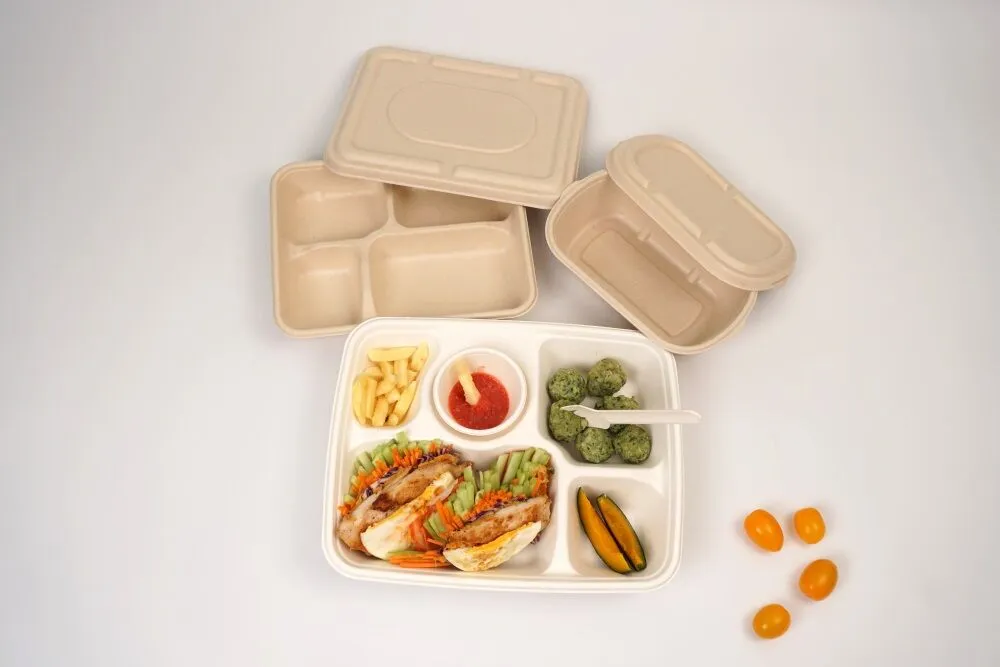
Conversely, consider large event catering or central kitchens. The food is often pre-plated and transported in bulk holding cabinets. The trays are not subjected to sudden lateral movements, but they face immense vertical pressure and the challenge of keeping discrete food items separated. In this scenario, heavy-duty molded fiber compartment trays are essential. The compartments prevent food migration during handling, and the rigid walls allow kitchen staff to load and unload thousands of units rapidly without the trays collapsing in their hands.
| Use Case Scenario | Primary Mechanical Stress | Critical Tray Feature |
| B2C Takeaway Delivery | Lateral vibration, tipping | Deep cavity, secure lid lock, leak-proof |
| B2B Event Catering | Handling speed, presentation | Compartment walls, anti-slip base |
| School/Hospital Meals | Standardized bulk portioning | Uniform multi-grid layout, high rigidity |
| Cold Chain/Frozen | Condensation, brittleness | Moisture barrier, low-temp stable material |
4. How Does Stacking Stability Impact Catering Operations?
Bulk food transport exposes packaging to intense vertical compression. When disposable catering trays fail under stacking pressure, kitchens face severe food waste, delayed service, and immediate damage to their brand reputation.
Stackability relies on vertical load-bearing corners and rigid lid interfaces to transfer weight through the container walls rather than the food. Utilizing stackable, deformation-resistant tray designs ensures commercial kitchens can transport bulk orders vertically without the bottom tiers collapsing or shifting.
Mitigating Vertical Compression Logistics
Restaurant-grade durability is ultimately proven in the transport vehicle. If you cannot safely stack multiple orders, your delivery logistics become highly inefficient, severely increasing operational costs.
Let us look at a central kitchen dispatching meals to satellite offices. If staff stack six standard, flimsy plastic trays, the combined weight causes the lid of the bottom tray to bow inward, crushing the food and potentially forcing the side walls to buckle outward, breaking the seal. By utilizing heavy-duty catering trays designed with specific geometric interlocking points, the base of the top tray sits perfectly onto the reinforced rim of the tray below it. This engineering choice directs the compressive force down the vertical side walls—the strongest axis of the container—rather than across the unsupported center of the lid.
A second example is cold-room storage. Prepped meals must often sit stacked in walk-in refrigerators overnight. Standard paper trays will absorb ambient humidity, weakening their structural integrity and causing the stack to lean or collapse by morning. A waterproof composite material ensures the compressive strength remains constant regardless of environmental humidity.
- Design Trade-off: Highly stackable trays often require a slight taper in the wall design, which can marginally reduce internal volume. Procurement must balance portion sizes against the required stacking taper.
- Practical Test: Perform the “Five-Stack Drop.” Stack five fully loaded trays and simulate a sudden vehicle stop by sliding them forcefully against a solid backboard. Ensure the stack remains interlocked and upright.
5. Why Are Custom OEM Configurations Essential for High-Volume Buyers?
Off-the-shelf packaging often forces restaurants to compromise on portion sizes or menu combinations. B2B buyers require tailored dimensions to optimize food presentation and streamline their standardized kitchen assembly lines.
Custom OEM mold forming allows procurement managers to specify tray depths, exact compartment layouts, and precise lid compatibility for unique menus. Partnering with a specialized factory ensures high-volume consistency, customized brand embossing, and exact dimensional tolerances across all durable disposable trays.
The Engineering Process of Custom Mold Forming
For international restaurant chains and major food distributors, relying on generic catalog dimensions is a severe operational bottleneck. A fraction of an inch in tray depth can mean the difference between a lid closing smoothly on an automated assembly line or creating a bottleneck of improperly sealed meals.
At Hengfeng High-Tech, we utilize 250-ton injection molding machines and imported American high-temperature mixers to execute custom OEM/ODM solutions. Consider a client specializing in premium bento boxes. An off-the-shelf tray might mix the hot rice with the cold salad. Through custom mold forming, we engineer a heavy duty disposable tray with distinct thermal barriers and specific volumetric cavities tailored exactly to their portion controls. Another example is brand visibility. Instead of relying on easily damaged stickers, we employ sophisticated relief craftsmanship to emboss the client’s corporate logo directly into the reinforced rim of the tray, ensuring permanent brand presence that withstands heat and grease.
Operating an ISO9001-certified, 10,000-square-meter sterile manufacturing facility allows us to guarantee that every custom mold produces identical structural tolerances, whether it is the first tray or the millionth.
| Sourcing Strategy | Tooling Flexibility | Brand Integration | Unit Consistency |
| Generic Wholesalers | None (fixed catalog) | Low (stickers/sleeves) | Variable (mixed suppliers) |
| Hengfeng Custom OEM | Full geometric control | High (embossed molds) | Exact (ISO9001 automation) |
Procurement Advice: When specifying a custom mold, always ask the factory for the tooling draft angle tolerances and the expected cycle life of the steel mold to ensure long-term production stability.
Conclusion
Selecting a heavy-duty disposable tray is an engineering decision, not just a procurement purchase. The industry is moving rapidly away from fragile plastics and weak paper toward high-density compostable materials and advanced cornstarch composites. By prioritizing structural features like reinforced rims, interlocking stackability, and compartment load-bearing walls over simple material thickness, food service operators can eliminate transit failures. Partnering with a proven, technology-driven manufacturer ensures you receive reliable, custom-tailored, restaurant-grade durability that protects both your product and the environment.
If you are currently sourcing heavy-duty disposable trays for catering, takeaway, or large-scale food distribution, we can support OEM/ODM customization based on your exact load, temperature, and compartment requirements. Share your product specifications, target use scenario, and expected order volume, and our engineering team will recommend the most suitable structural design and material configuration to minimize transit failure and packaging cost. Contact us to request samples or a technical quotation.
Frequently Asked Questions (FAQ)
1. What defines a heavy-duty disposable tray compared to a standard tray?
A heavy-duty tray features engineered structural enhancements such as reinforced rims, molded anti-slip channels, and dense material compositions (like cornstarch composites or molded bagasse) designed to handle loads of up to 5 lbs without bending or leaking.
2. Can heavy duty food trays safely hold boiling liquids or hot frying oil?
Yes, provided they are made from high-performance materials. Our cornstarch and PPT composite formulation is stable in operating temperatures ranging from -5°C to 125°C, making it impervious to hot oil and boiling liquids.
3. Are durable disposable trays environmentally friendly?
Modern high-strength trays certainly can be. Innovations in composite manufacturing mean that you no longer have to sacrifice durability for sustainability. Our cornstarch-based trays are fully biodegradable and break down without leaving toxic residue.
4. Why is compartment design important for heavy-duty catering applications?
Compartment walls act as internal support pillars, significantly increasing the overall flexural strength of the tray. This prevents the tray from buckling when carried with one hand and keeps different food types completely separated during transit.
5. How does moisture affect compostable heavy duty trays?
Standard untreated pulp can absorb moisture, leading to softening. However, advanced solutions like injection-molded cornstarch composites are inherently waterproof and oil-proof, ensuring the tray maintains absolute rigidity even in high-humidity cold chains or under heavy sauces.
6. Do you offer custom dimensions for bagasse food trays wholesale equivalent products?
Yes, we specialize in comprehensive OEM/ODM customization. We support custom mold forming, allowing buyers to specify precise tray depths, exact compartment layouts, and sophisticated logo embossing to fit their unique operational requirements.
7. How can I ensure the trays won’t collapse when stacked in a delivery van?
You must specify trays designed with interlocking geometric rims and specific downward-force load distribution paths. Proper engineering directs the vertical weight down the structural walls rather than across the flexible lids, ensuring high stackability.