Inconsistent packaging supply and failing containers cause severe operational bottlenecks and customer complaints for large restaurant chains. Ignoring supplier reliability leads to food leaks, inventory stockouts, and permanent brand damage. To choose the right disposable food container supplier, restaurant chains must prioritize scalable production capacity, commercial-grade thermal performance, rigorous food-safety compliance, and comprehensive OEM customization capabilities over the lowest raw unit price.
Table of Contents
- Assess Production Capacity and Supply Chain Stability
- Evaluate Container Performance for Demanding Foodservice Conditions
- Verify Material Safety and Food-Grade Compliance
- Examine OEM Customization and Private Label Capabilities
- Calculate the Total Cost of Ownership vs. Lowest Unit Price
- Why Restaurant Chains Partner with Hfenggreen
1. Assess Production Capacity and Supply Chain Stability
For multi-location restaurant chains, a localized packaging stockout is a critical failure that directly halts daily revenue. Supplier reliability is paramount to maintaining seamless franchise operations.
A reliable disposable food container supplier must guarantee stable bulk supply through factory-direct operations, high monthly production capacity (exceeding 300 tons), and robust inventory management to prevent supply chain disruptions across all restaurant branches.
Facility Scale and Output Metrics
Chain operations demand immense volume and absolute consistency between production batches. When evaluating a bulk food container supplier, procurement managers must audit the physical manufacturing footprint. A legitimate partner operates large-scale facilities—such as a 10,000+ square meter manufacturing plant—equipped with automated production lines. A monthly production capacity of up to 350 tons ensures that the manufacturer can absorb sudden spikes in demand, whether driven by seasonal promotions, new menu launches, or rapid franchise expansion, without compromising on delivery timelines.
Mitigating Supply Chain Risks
Relying on trading companies or small-scale intermediaries introduces severe supply chain vulnerabilities. Factory-direct wholesale supply provides restaurant chains with direct access to production schedules and raw material inventory buffers. Direct manufacturers maintain continuous procurement of raw materials and operate dedicated production lines for their high-volume clients. This structural advantage ensures consistent output and reliable delivery schedules, insulating the restaurant chain from broader market shortages or logistical delays.
2. Evaluate Container Performance for Demanding Foodservice Conditions
Takeaway and food delivery operations expose packaging to extreme conditions, from boiling soups and heavy curries to rough handling during transit. Basic product appearance is irrelevant if the container fails under pressure.
Commercial-grade food containers must provide exceptional thermal stability (from -5°C to 125°C), robust oil and water resistance, and secure, leak-proof designs to maintain food integrity during long delivery routes.
Thermal Resistance and Temperature Extremes
A restaurant food packaging supplier must provide solutions engineered for diverse menu items. Traditional plastics or low-grade bioplastics often warp, melt, or leach when exposed to high heat. High-performance biodegradable tableware, such as premium cornstarch containers, offers heat resistance up to approximately 125°C. This ensures the structural integrity remains intact when holding steaming hot meals, preventing dangerous spills. Furthermore, these containers must exhibit freezer performance down to approximately -5°C, accommodating both hot delivery and cold-chain catering applications without becoming brittle or shattering. They must also be fully suitable for microwave food applications, allowing end-consumers to safely reheat leftovers.
Structural Integrity and Leak Prevention
Delivery businesses require containers that protect food quality and presentation from the kitchen to the customer’s dining table. A critical metric for takeaway food container suppliers is the dimensional tolerance of container lids and bases. Precision engineering ensures a tight, leak-resistant seal that prevents sauces and liquids from spilling during transit. Additionally, the material formulation must be inherently oil-resistant and water-resistant. If a container absorbs grease or moisture, it loses its stacking strength, leading to crushed orders and compromised customer experiences. Robust stacking strength is non-negotiable for busy kitchens and delivery drivers handling multiple orders simultaneously.
3. Verify Material Safety and Food-Grade Compliance
Sourcing eco-friendly packaging must not compromise consumer safety or regulatory standing. As restaurants transition away from conventional plastics, the scientific validation of alternative materials is critical.
Procurement managers must verify that an eco-friendly food packaging manufacturer uses certified food-contact safe materials, such as renewable non-GMO cornstarch, supported by comprehensive safety testing and regulatory compliance documentation.
Renewable Plant-Based Material Science
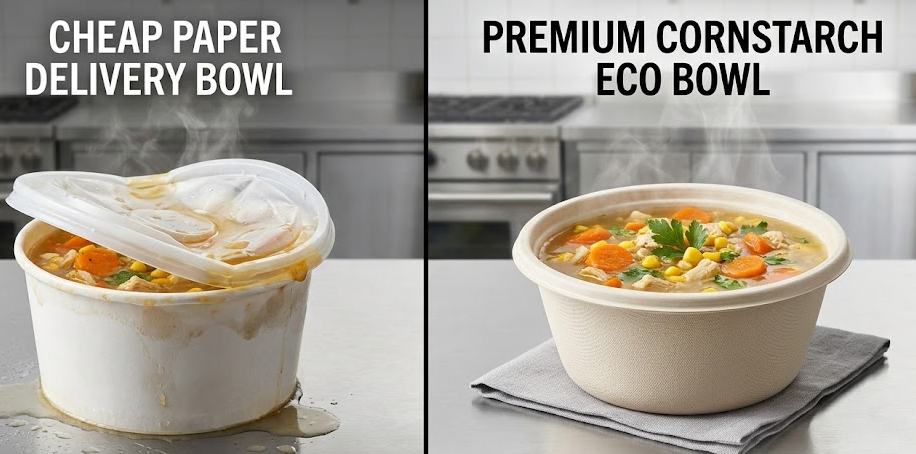
The shift toward sustainable operations requires packaging that balances environmental responsibility with commercial viability. Leading compostable food packaging suppliers utilize bio-based composites, predominantly utilizing non-GMO cornstarch. This renewable plant-based material is plasticized and formed to create a durable, heavy-duty matrix that serves as a direct alternative to conventional plastic packaging. Unlike flimsy paper alternatives that require synthetic chemical coatings, cornstarch-based tableware provides intrinsic barrier properties while remaining an industrially compostable biodegradable solution.
Regulatory Compliance and Batch Testing
For chain restaurants, packaging suppliers must meet strict, documented safety requirements. A qualified disposable food container manufacturer will implement stringent quality-controlled production processes. This includes batch testing to ensure no chemical migration occurs when the material interacts with highly acidic, alkaline, or high-temperature foods. Providing verifiable food-grade compliance documentation protects the restaurant brand from regulatory fines and consumer health liabilities, ensuring every location serves food in thoroughly vetted, safe materials.
4. Examine OEM Customization and Private Label Capabilities
Packaging is a primary touchpoint for a restaurant’s brand identity. Generic, off-the-shelf containers represent a missed opportunity for brand reinforcement and menu-specific portion control.
An expert OEM food container manufacturer must offer extensive customization, including bespoke container sizes, proprietary mold development, brand logo printing, and customized private label solutions to strengthen restaurant brand recognition.
Custom Tooling and Size Configurations
Standardized food containers rarely fit the unique presentation requirements of signature dishes. Growing food brands often require custom sizes, specific compartment layouts (such as bento-style dividers), or specialized ventilation for fried foods. A sophisticated supplier possesses in-house engineering capabilities to develop proprietary molds. This allows restaurant chains to dictate exact volumetric capacities for precise portion control, ultimately reducing food waste and standardizing operational costs across all franchise locations.
Brand Printing and Private Label Production
Private label restaurant brands rely heavily on custom packaging to differentiate themselves in a crowded delivery marketplace. An advanced supplier facilitates comprehensive brand printing options, from custom-embossed logos on container lids to fully branded outer carton packaging. This OEM customization support ensures that the unboxing experience reflects the restaurant’s quality standards, strengthening brand loyalty and driving repeat business.
5. Calculate the Total Cost of Ownership vs. Lowest Unit Price
Procurement based solely on the lowest unit cost is a flawed strategy that frequently results in catastrophic hidden expenses for large-scale foodservice operations.
Professional restaurant buyers calculate the total cost of ownership by evaluating product consistency, defect rates, customer complaint resolution costs, and packaging failure risks, rather than just comparing the initial wholesale unit price.
The Hidden Costs of Inferior Packaging
When a restaurant chain opts for a low-cost, low-quality disposable tableware wholesale supplier, they inevitably inherit downstream operational failures. A container that leaks during delivery does not just waste the cost of the packaging; it ruins the food, forces a full monetary refund, triggers negative online reviews, and permanently alienates the customer. Furthermore, inconsistent quality between different production batches forces kitchen staff to discard defective units, directly inflating the actual cost per usable container. A reliable supplier helps restaurants reduce these hidden packaging costs by delivering engineered consistency.
Supplier Evaluation Matrix
| Evaluation Criteria | Sub-Standard Packaging Supplier | Professional Direct Manufacturer | Impact on Restaurant Operations |
| Defect & Leakage Rate | High variance; loose lids and weak seams. | Strict tolerances; guaranteed tight seals. | Prevents costly food refunds and negative delivery app reviews. |
| Thermal Performance | Deforms or melts with hot food (>60°C). | Stable up to 125°C and down to -5°C. | Allows safe transport of boiling soups and safe microwave reheating. |
| Supply Stability | Prone to stockouts; relies on third parties. | 350-ton monthly capacity; factory direct. | Ensures continuous franchise operations without packaging shortages. |
| Customization (OEM) | Generic sizes only; high custom mold fees. | In-house mold design; fast private labeling. | Enables unique brand identity and exact menu portion control. |
| Total Cost | Low unit price, high hidden failure costs. | Competitive wholesale price, zero failure costs. | Maximizes overall profitability and protects brand reputation. |
6. Why Restaurant Chains Partner with Hfenggreen
Hfenggreen has engineered its entire manufacturing ecosystem to solve the specific scalability, customization, and quality challenges faced by global restaurant chains and food delivery brands.
Hfenggreen is a premier factory-direct manufacturer offering a 350-ton monthly capacity, commercial-grade biodegradable cornstarch containers (stable from -5°C to 125°C), and full OEM customization to support the demanding needs of large-scale foodservice operations.
Scalable Production for Multi-Location Brands
Operating from a state-of-the-art 10,000+㎡ manufacturing facility, Hfenggreen provides the foundational stability that restaurant groups require. With a massive production capacity of up to 350 tons per month, we guarantee factory-direct wholesale supply that never falters. This stable bulk supply ensures continuous operations for daily food services, large catering events, and rapidly expanding franchise networks. Our quality-controlled production process ensures that batch number one thousand performs identically to batch number one.
Purpose-Built for Delivery and Catering
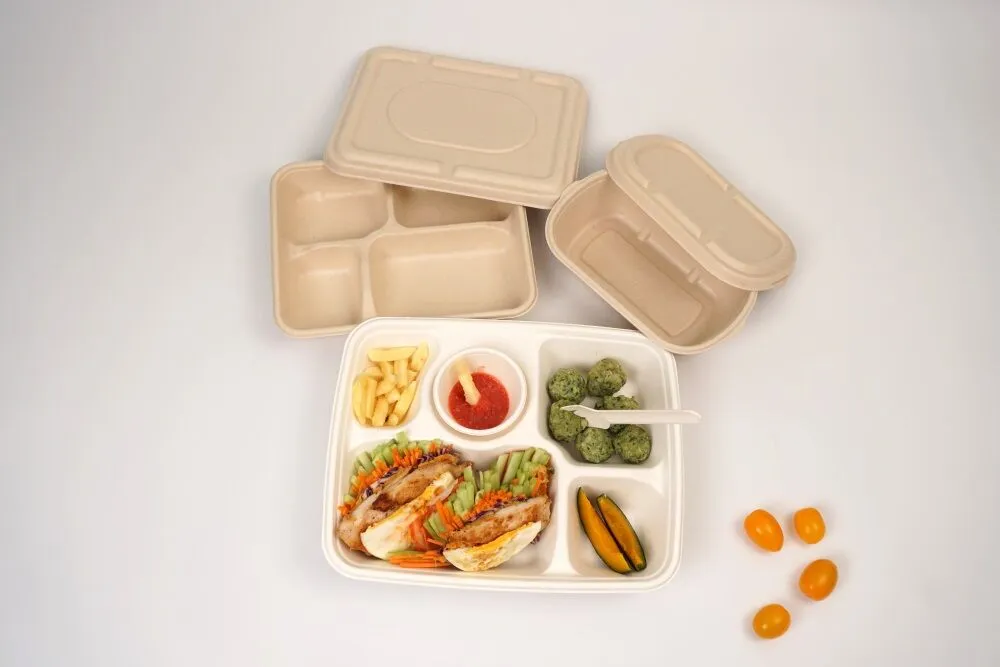
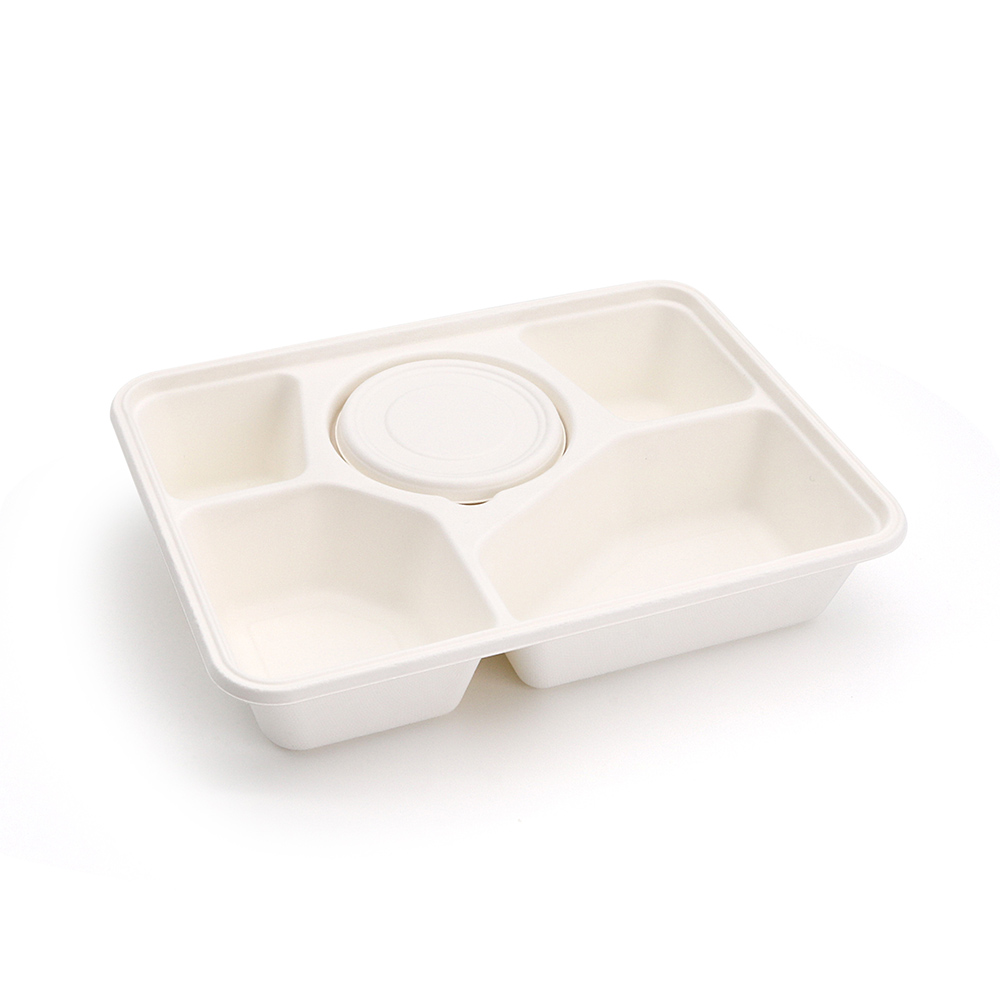
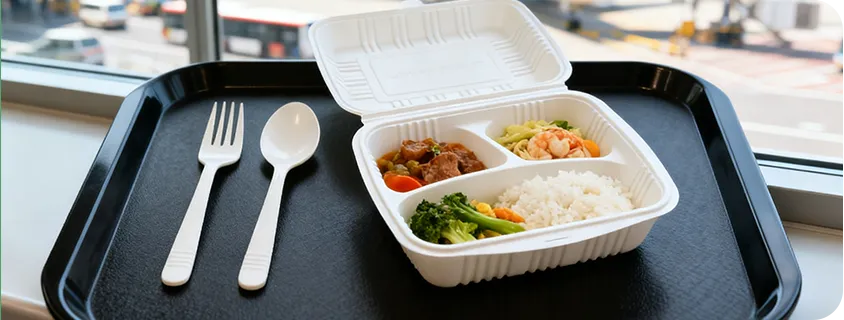
Our product range—including cornstarch lunch boxes, hinged takeaway containers, soup bowls, cutlery sets, and catering trays—is specifically engineered for the rigors of modern food delivery. Utilizing renewable, non-GMO plant-based materials, our compostable solutions act as a superior alternative to conventional plastics. They are oil-resistant, water-resistant, and feature leak-resistant design options. Capable of withstanding extreme temperatures from a freezing -5°C up to a blistering 125°C, Hfenggreen’s products protect food quality, prevent container deformation, and ultimately elevate the customer experience for takeaway and delivery brands worldwide.
Conclusion
Choosing the right disposable food container supplier requires procurement managers to look far beyond the initial wholesale price. By prioritizing a factory-direct manufacturer with immense production capacity, commercial-grade thermal and structural performance, verifiable food-safe materials, and robust OEM customization capabilities, restaurant chains can eliminate supply chain bottlenecks and protect their brand equity. Integrating high-performance biodegradable solutions ensures that commercial operational needs are met while advancing corporate sustainability goals.
Ready to secure a reliable, high-performance packaging supply chain for your restaurant brand?
Contact the engineering and procurement specialists at Hfenggreen today to request technical consultation, order product samples for kitchen evaluation, or receive a customized quotation for your next bulk roll-out.
FAQ
How do your biodegradable food containers perform compared to traditional plastic packaging?
Our non-GMO cornstarch-based containers are engineered as a direct alternative to conventional plastics. They offer equivalent or superior stacking strength, oil and water resistance, and structural integrity, while providing the environmental benefit of being an industrially compostable biodegradable solution.
What temperature range can your takeaway food containers withstand during delivery?
Hfenggreen containers offer exceptional thermal stability. They are heat resistant up to approximately 125°C, making them perfectly safe for boiling soups and hot meals, and maintain freezer performance down to approximately -5°C. They are also entirely suitable for microwave food applications.
Can you ensure a stable bulk supply for a rapidly expanding restaurant franchise?
Yes. As a factory-direct supplier operating a 10,000+㎡ manufacturing facility, we maintain a production capacity of up to 350 tons per month. This massive scale ensures continuous operations, consistent output, and a reliable delivery schedule for large restaurant groups.
Do you offer custom sizes and OEM designs for unique restaurant menu items?
Absolutely. We provide comprehensive OEM customization support. This includes developing custom molds for specific container sizes and compartment layouts, as well as brand printing options and private label production to strengthen your restaurant’s brand identity.
How does investing in leak-resistant packaging impact the total cost for food delivery brands?
While inferior packaging might have a slightly lower unit price, it leads to container deformation, food leaks, customer complaints, and costly refunds. Our leak-resistant design options prevent these failures, significantly lowering the total cost of ownership and protecting your brand reputation.
Are your eco-friendly food packaging solutions certified for direct food contact?
Yes. All of our disposable tableware and packaging solutions are manufactured using strict quality-controlled production processes and utilize certified food-contact safe materials, ensuring full compliance for commercial restaurant use.