Sourcing food packaging from unverified overseas intermediaries often leads to inconsistent batch quality, sudden supply chain disruptions, and devastating customs compliance failures. Ignoring the rigorous vetting of manufacturing capabilities directly inflates operational risks and hidden procurement costs. To successfully source disposable tableware from China, international buyers must bypass trading intermediaries and evaluate direct manufacturers based on production capacity, food-grade material compliance, OEM tooling capabilities, and overall export reliability.
Table of Contents
- Verify Direct Manufacturer Status Over Trading Companies
- Evaluate Bulk Production Capacity and Supply Stability
- Assess Material Quality, Performance, and Compliance
- Examine OEM and Private Label Customization Capabilities
- Analyze Total Sourcing Value vs. Lowest Unit Price
- Why Hfenggreen is the Ideal Disposable Tableware Supplier in China
1. Verify Direct Manufacturer Status Over Trading Companies
The most common critical error international food packaging distributors make is unknowingly partnering with trading companies disguised as factories. This misalignment introduces severe communication bottlenecks, uncontrolled markups, and a complete lack of quality oversight during the production phase.
To verify a disposable tableware supplier in China, buyers must demand proof of a physical manufacturing facility (exceeding 10,000㎡), request live factory video audits, and confirm that the business license specifically highlights manufacturing capabilities rather than general trading.
Supply Chain Transparency and Risk Mitigation
When an importer works with a trading company, they lose visibility into the actual production line. If a batch of disposable food containers suffers from thinning walls or weak lid seals, the trading company cannot immediately halt the extrusion or thermoforming machines. A factory-direct disposable tableware supplier, however, maintains total control over its In-Process Quality Control (IPQC). By partnering directly with the factory, international buyers eliminate the intermediary markup, gaining better cost control and the ability to instantly address technical issues on the production floor.
Direct Engineering Communication
Sourcing complex packaging solutions requires precise technical dialogue. Importers supplying restaurants and catering businesses often need specific dimensional tolerances to fit proprietary food trays or delivery bags. Direct factory access allows overseas procurement teams to communicate directly with tooling engineers and material scientists. This drastically accelerates the product development cycle, ensuring that specifications for weight, thickness, and thermal resistance are accurately translated into the final manufactured product.
2. Evaluate Bulk Production Capacity and Supply Stability
For high-volume international buyers, a supplier’s inability to scale production is a fatal flaw. A factory that cannot fill multiple 40HQ (High Cube) shipping containers consistently will cause stockouts, halting downstream restaurant and distribution operations across global markets.
A reliable China disposable tableware manufacturer must demonstrate a minimum monthly production capacity of 300 tons to absorb large international wholesale orders, ensure stable raw material inventory, and guarantee on-time delivery schedules without seasonal disruptions.
Manufacturing Scale and Automation Metrics
When evaluating bulk disposable food packaging suppliers, physical infrastructure dictates output reliability. A qualified manufacturing partner operates a large-scale facility—typically over 10,000 square meters. This space is necessary to house advanced, automated extrusion lines, large-scale thermoforming presses, and dedicated automated trimming machinery. For instance, a proven production capacity of up to 350 tons per month indicates that the factory operates highly automated, continuous-shift production capable of serving multiple global wholesale accounts simultaneously without lead-time blowouts.
Raw Material Supply Chain Resilience
Consistent manufacturing relies heavily on the upstream raw material supply. Professional manufacturers do not rely on spot purchasing for their bioplastics; they secure long-term contracts for their non-GMO cornstarch resins and plant-based renewable materials. This stable raw material supply ensures that the chemical composition and structural integrity of the compostable food containers remain identical from batch to batch, year after year. This consistency is vital for international food brands that require exact uniformity across their global franchise networks.
3. Assess Material Quality, Performance, and Compliance
The global transition away from traditional single-use plastics means international buyers must source sustainable alternatives that do not sacrifice commercial performance. The materials chosen must withstand extreme temperatures and aggressive handling during global transit.
Qualified suppliers must provide compostable food containers that withstand extreme temperatures (-5°C to 125°C), feature inherent oil and water resistance, and possess verifiable documentation proving strict adherence to international food-contact safety standards.
Advanced Bio-Composites and Cornstarch Engineering
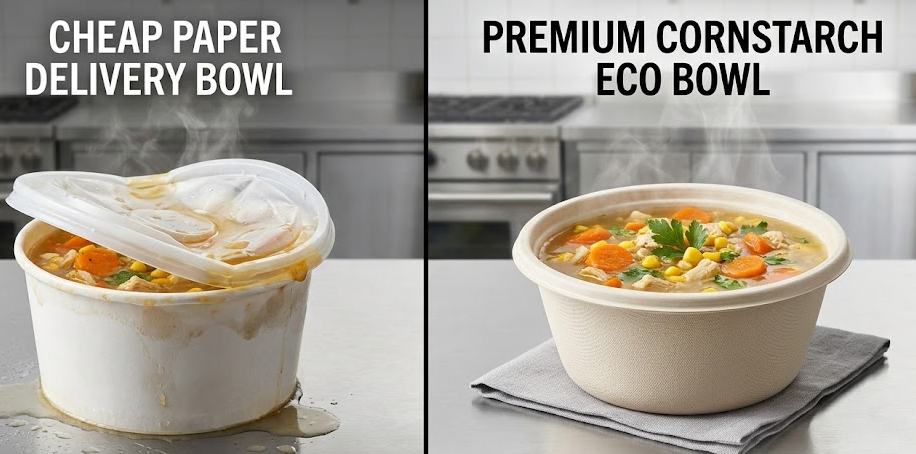
A leading biodegradable tableware manufacturer in China utilizes advanced bio-composites, predominantly non-GMO cornstarch. Through a sophisticated plasticization process, this renewable plant material is transformed into a high-density matrix. Unlike standard paper products that require chemical liners to prevent sogginess, engineered cornstarch tableware is intrinsically water-resistant and oil-resistant. It serves as a direct, heavy-duty alternative to conventional plastic, providing the high structural strength required for international transportation and daily, high-volume foodservice use.
Thermal Resistance and Regulatory Compliance
Food packaging must perform flawlessly under stress. Premium cornstarch tableware offers remarkable thermal stability, boasting heat resistance up to approximately 125°C. This makes it ideal for hot meals, boiling soups, and demanding takeaway food delivery applications. Furthermore, it supports freezer use down to approximately -5°C without shattering. Crucially, a legitimate eco-friendly food packaging factory will back these performance metrics with comprehensive compliance documentation, proving the materials are certified food-contact safe and support industrial compostability, protecting the buyer from regulatory friction at the destination port.
4. Examine OEM and Private Label Customization Capabilities
International food brands and private label businesses do not just buy packaging; they invest in their brand’s physical presentation. A supplier limited to generic catalog items cannot support the growth of a customized international brand.
An expert OEM disposable tableware manufacturer provides end-to-end customization, including custom product design, proprietary mold development for unique sizes, logo printing, and tailored private label packaging for overseas markets.
Proprietary Mold Development and Tooling
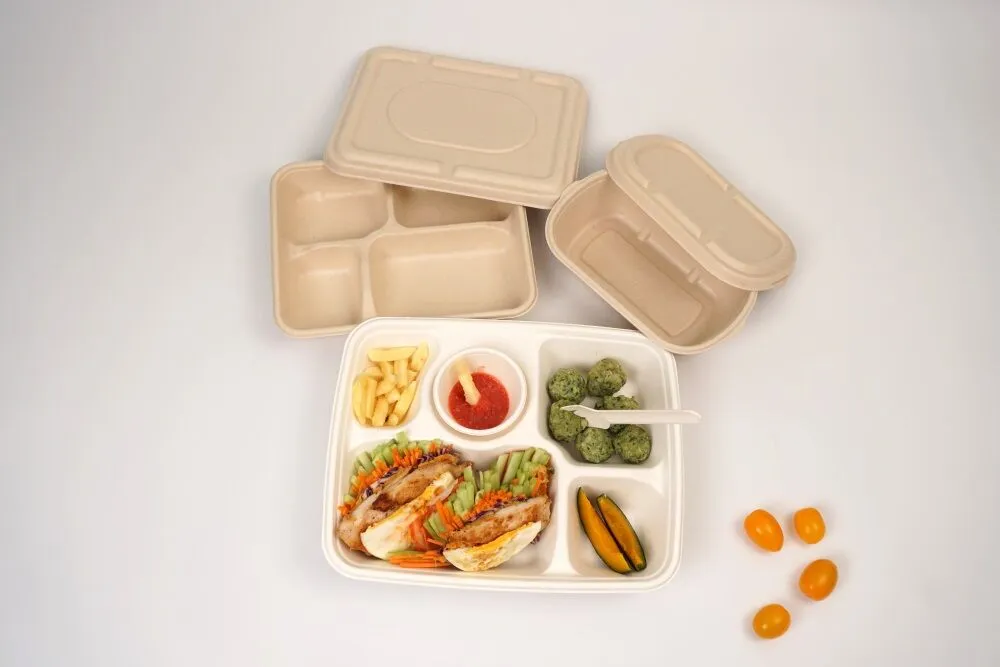
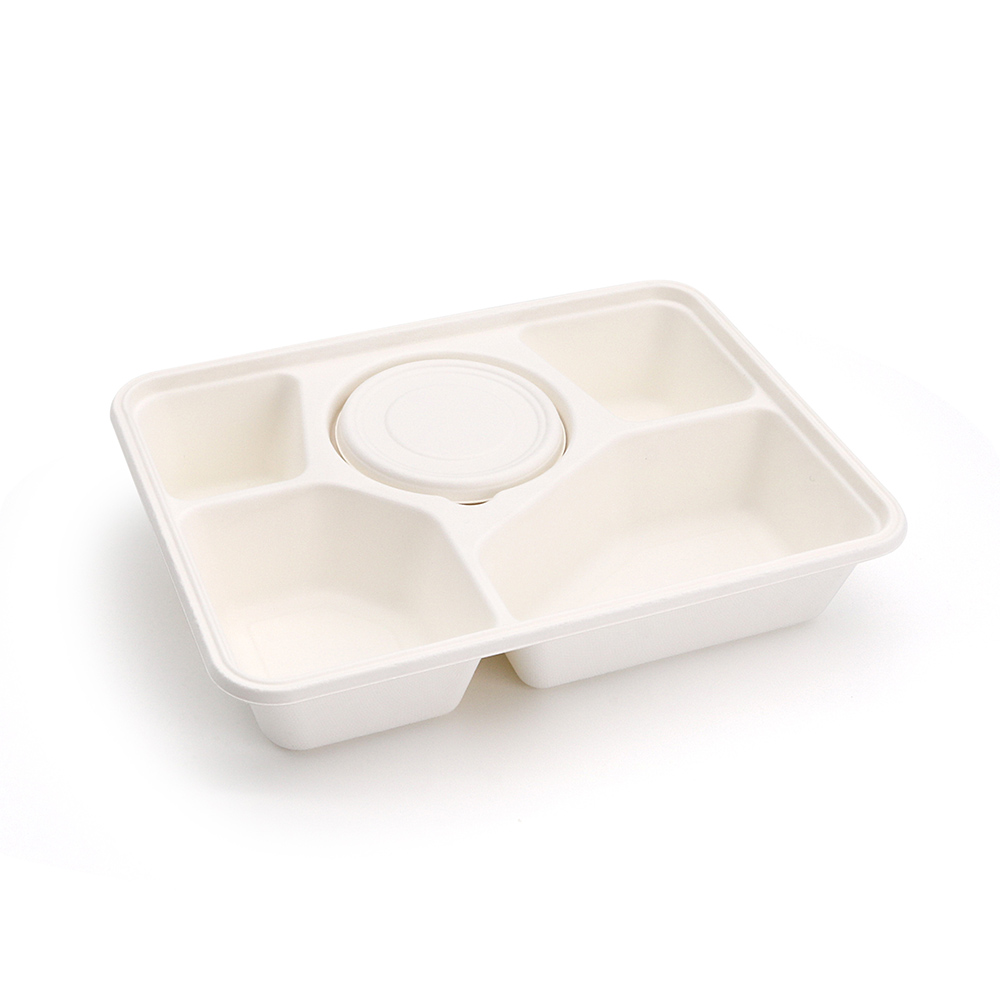
Different global markets demand distinct portion sizes and container formats. An advanced manufacturer offers a comprehensive OEM customization process that covers every stage of product development. This begins with specification confirmation via 3D CAD modeling, followed by precision tooling and mold making. Whether a buyer requires a specific multi-compartment lunch box or unique disposable cutlery sets, the factory must be able to produce accurate samples for physical testing before transitioning seamlessly into high-volume mass production.
Brand Customization and Export-Ready Packaging
For restaurant supply importers, the outer packaging is just as important as the product inside. A reliable factory accommodates flexible packaging options, including custom-printed inner sleeves, branded master cartons, and retail-ready display boxes. This allows international distributors to receive export-ready packaging that can be immediately routed to end-users without the costly and time-consuming need for secondary repackaging at domestic warehouses.
5. Analyze Total Sourcing Value vs. Lowest Unit Price
Chasing the absolute lowest unit price on B2B sourcing platforms is a dangerous strategy that routinely backfires. The initial savings are rapidly eclipsed by the costs associated with defective products, delayed shipments, and lost clients.
International buyers must evaluate the total sourcing value by calculating unit price alongside product defect rates, communication efficiency, long-term supply reliability, and reduced logistical risks, rather than choosing the cheapest quote.
The Financial Impact of Sourcing Inefficiencies
When a buyer selects a sub-standard supplier, they expose their supply chain to massive hidden costs. Containers with inconsistent wall thickness will warp or leak, resulting in rejected shipments upon arrival. Furthermore, poor communication efficiency leads to manufacturing errors that require complete production restarts, delaying shipments by months. A professional factory acts as a long-term supply partner, actively reducing these risks through strict quality inspection procedures, optimized container loading (to maximize freight efficiency), and consistent batch quality.
Supplier Evaluation and Sourcing Matrix
| Evaluation Criteria | Unverified Trading Company | Professional Direct Factory | Impact on International Buyers |
| Manufacturing Transparency | Opaque; outsources to cheapest bidder. | 10,000+㎡ facility; open to live video audits. | Ensures consistent quality and protects buyer reputation. |
| Production Capacity | Highly variable; prone to severe delays. | Up to 350 tons per month. | Guarantees on-time shipping for bulk wholesale orders. |
| Material Performance | Unverified origins; melts under high heat. | Non-GMO cornstarch; stable from -5°C to 125°C. | Meets commercial foodservice demands (hot/cold safe). |
| OEM & Customization | High markups on custom molds; slow R&D. | In-house engineering; fast prototyping & tooling. | Enables rapid launch of private label food brands. |
| Total Sourcing Value | High hidden costs due to defects and delays. | Factory-direct pricing with zero defect costs. | Maximizes overall profitability and supply chain stability. |
6. Why Hfenggreen is the Ideal Disposable Tableware Supplier in China
Hfenggreen has deliberately structured its manufacturing operations to solve the specific capacity, compliance, and customization challenges faced by international food packaging buyers.
Hfenggreen is a premier factory-direct biodegradable tableware manufacturer in China, offering a 350-ton monthly capacity, a 10,000㎡ facility, comprehensive OEM support, and high-performance cornstarch packaging designed for global foodservice importers.
Engineered for Global Wholesale and Distribution
Hfenggreen specializes in plant-based food packaging solutions engineered to replace conventional plastics. Our product range—which includes disposable lunch boxes, soup bowls, cutlery sets, and catering trays—utilizes non-GMO cornstarch-based material. These products are rigorously tested to ensure food-contact safety, water resistance, and oil resistance. With an impressive temperature tolerance ranging from -5°C up to approximately 125°C, our tableware easily handles the most demanding hot meal delivery and cold-chain catering applications worldwide.
A Proven Partner for International Growth
We understand that international food packaging distributors and importers require more than just products; they require a stable supply chain partner. Operating from a massive 10,000+㎡ manufacturing facility, Hfenggreen provides an astounding production capacity of up to 350 tons per month. We offer full-spectrum OEM and private label capabilities—from custom molds to bespoke carton printing—backed by a deeply integrated, quality-controlled production process. By choosing Hfenggreen as your factory-direct partner, you secure a highly competitive, reliable, and sustainable packaging supply chain for your long-term global growth.
Conclusion
Sourcing disposable tableware from China requires a strategic, analytical approach to supplier selection. By moving beyond basic price comparisons and rigorously evaluating a factory’s true production capacity, material compliance, thermal performance, and OEM tooling capabilities, international buyers can eliminate supply chain vulnerabilities. Partnering with a large-scale, direct manufacturer ensures product consistency, reduces total sourcing costs, and positions your brand to capitalize on the soaring global demand for sustainable packaging.
Ready to optimize your international packaging supply chain?
Contact the export manufacturing experts at Hfenggreen today to request a comprehensive technical consultation, order product samples for regional testing, or receive a customized, factory-direct quotation for your next bulk wholesale shipment.
FAQ
How can I verify if a China disposable tableware supplier is a real factory?
You should request a live video tour of the production floor, ask for documentation proving the facility size (ideally over 10,000㎡), and review their business license to ensure it explicitly covers manufacturing and extrusion, rather than solely listing export or trading activities.
What is the minimum production capacity I should look for in a bulk supplier?
For stable international wholesale supply, look for a factory with a monthly production capacity of at least 300 to 350 tons. This volume ensures they have the automated machinery and raw material stock required to fulfill multiple container orders without delaying your shipments.
Is cornstarch tableware functionally equivalent to traditional plastic?
Yes, high-quality non-GMO cornstarch tableware is engineered as a heavy-duty alternative to conventional plastic. It provides superior structural strength, intrinsic water and oil resistance, and can safely withstand extreme commercial temperatures ranging from -5°C up to approximately 125°C.
Does Hfenggreen support custom OEM tooling for private label brands?
Absolutely. We offer an end-to-end OEM customization process. This includes 3D specification confirmation, custom mold development for unique container sizes, brand logo printing, and tailored export-ready packaging to support the specific needs of international food brands.
What compliance documents should I request for importing food packaging?
You must request verifiable third-party testing reports confirming the materials are food-contact safe, free from harmful heavy metals or toxic plasticizers, and meet the specific industrial compostability and regulatory standards required by your destination country’s customs authority.
How does working with a direct factory reduce my total sourcing costs?
A direct factory eliminates the profit markups of trading companies while drastically reducing the hidden costs of poor quality. Direct communication prevents manufacturing errors, while consistent batch quality and optimized shipping configurations eliminate product rejections and lower your overall freight costs.