As environmental regulations tighten globally, relying solely on traditional plastic lunch boxes exposes food businesses to compliance risks and negative consumer perception. For food businesses, the best packaging solution balances operational cost, thermal performance, and sustainability; upgrading to high-performance, leak-resistant corn starch lunch boxes provides a strategic advantage over petroleum-based plastics by meeting eco-friendly demands without sacrificing food safety.
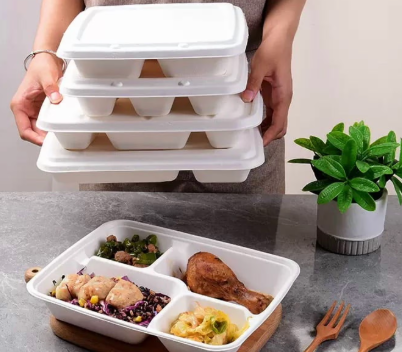
Table of Contents
- Evaluate Material Source and Environmental Impact
- Compare Heat Resistance and Food Compatibility
- Analyze Structural Design and Delivery Performance
- Assess Branding Value and Customer Perception
- Leverage OEM Customization for Brand Identity
- Balance Long-Term Costs with Stable Wholesale Supply
- Why Hfenggreen is the Ideal Partner for Biodegradable Solutions
1. Evaluate Material Source and Environmental Impact
The fundamental difference between traditional and modern food packaging lies in raw material sourcing and the product’s end-of-life cycle. Procurement managers must evaluate the long-term environmental footprint of their supply chain.
Corn starch lunch boxes utilize renewable, plant-based materials designed for industrial compostability, whereas plastic lunch boxes rely on depleting petroleum resources that generate long-term landfill waste. Businesses must weigh immediate unit costs against evolving environmental regulations.
Petroleum-Based Plastics vs. Renewable Plant Materials
For decades, plastic lunch boxes have dominated the market due to low material costs and a mature manufacturing process that yields strong mechanical performance. However, these petroleum-based polymers (such as standard PP or PS) take centuries to degrade, contributing massively to microplastic pollution. Conversely, biodegradable lunch boxes are manufactured using bio-composites, predominantly utilizing non-GMO corn starch. This renewable plant-based material drastically reduces the carbon footprint of the manufacturing process and decreases the food service industry’s reliance on fossil fuels.
Compostability and Waste Reduction
The end-of-life scenario is a critical metric for large-scale catering companies and corporate cafeterias. Traditional plastic creates a perpetual waste management problem. In contrast, advanced corn starch food containers are engineered for compostable applications. Under suitable industrial composting conditions, these materials break down naturally, allowing food delivery businesses and institutional caterers to align with strict municipal waste regulations and corporate sustainability targets.
Material and Operational Comparison Matrix
| Comparison Factor | Corn Starch Lunch Boxes | Plastic Lunch Boxes | Business Impact |
| Material Source | Renewable plant-based material (Non-GMO). | Petroleum-based plastic polymers. | Reduces supply chain reliance on volatile fossil fuels. |
| Environmental Impact | Designed for compostable applications; leaves no toxic residue. | Creates long-term plastic waste; faces increasing global bans. | Ensures compliance with future municipal packaging regulations. |
| Heat Performance | Suitable for hot food applications and microwaving. | Highly dependent on plastic type (some warp or leach chemicals). | Guarantees food safety and container integrity during hot delivery. |
| Branding Value | Actively supports sustainable brand positioning. | Offers limited to zero environmental advantages. | Elevates brand equity among eco-conscious consumer demographics. |
| Customer Perception | Meets the rapidly growing demand for eco-friendly packaging. | Increasingly questioned and rejected by modern consumers. | Directly influences customer retention and positive brand reviews. |
2. Compare Heat Resistance and Food Compatibility
A food container is only viable if it can survive the harsh physical realities of commercial kitchens and delivery logistics. The packaging must protect the food without degrading under thermal stress.
High-quality corn starch lunch boxes offer robust heat resistance suitable for hot meals, rice dishes, and microwaving, directly matching the thermal stability and barrier properties of traditional plastic containers without the associated environmental guilt.
Thermal Performance in Hot Food Delivery
Restaurants and takeaway businesses require containers that maintain structural integrity when exposed to high temperatures. While certain heavy-duty plastics offer good heat resistance, lower-grade plastics often warp, melt, or release harmful chemical plasticizers into the food. Corn starch takeaway containers are engineered to withstand significant thermal loads, making them perfectly suited for hot meals, freshly cooked rice dishes, fried food, and combination meals. They maintain their rigidity from the prep station to the customer’s dining table, ensuring a safe and premium unboxing experience.
Barrier Properties: Oil and Water Resistance
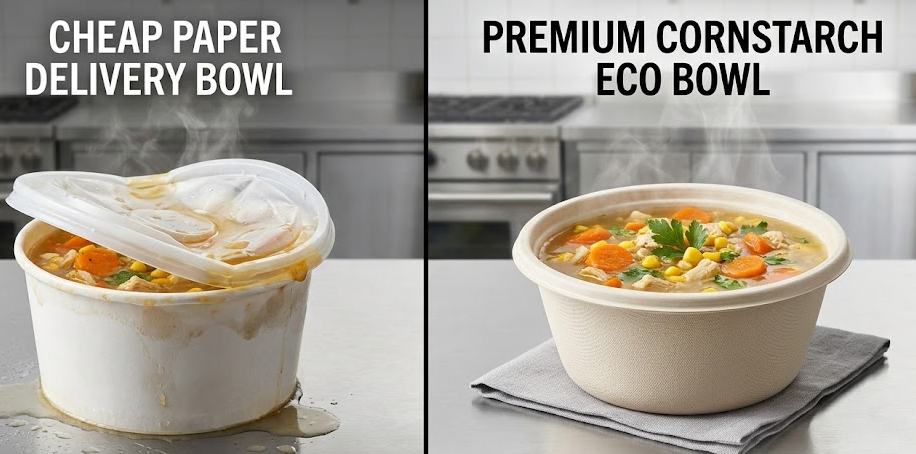
Leakage is the leading cause of customer complaints in the food delivery sector. Traditional plastic is inherently waterproof, setting a high benchmark for performance. Modern biodegradable lunch boxes match this standard through advanced material formulation. A professional eco-friendly food packaging manufacturer ensures that their corn starch composite is strictly food-contact safe and possesses intrinsic water-resistant and oil-resistant properties. This prevents heavy sauces, cooking oils, and acidic dressings from penetrating the container walls, eliminating the risk of soggy packaging or catastrophic leaks during transit.
3. Analyze Structural Design and Delivery Performance
The physical geometry of the container dictates operational efficiency in the kitchen and the presentation quality upon delivery. Different business models require specific structural solutions.
Both corn starch and plastic containers offer clamshell designs for rapid packing and multi-compartment structures for complex meals; however, precision-engineered corn starch containers deliver the secure lid closures and stable stacking essential for leak-free food delivery platforms.
Clamshell Designs for Fast Food Logistics
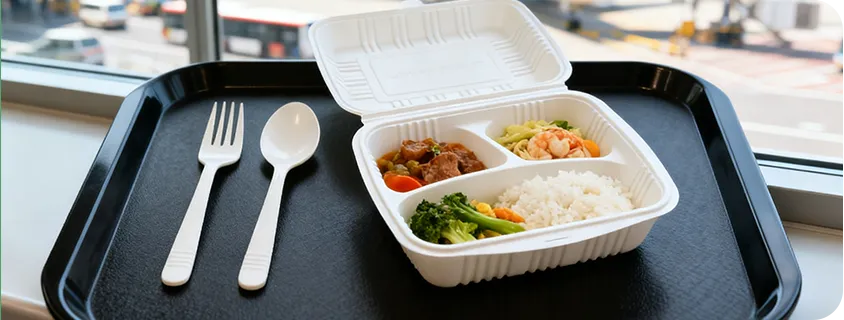
For fast food restaurants and high-volume takeaway services, packing speed is a critical operational metric. Clamshell designs—where the lid and base are hinged together—are highly efficient. This structure allows kitchen staff to close and secure the meal in a fraction of a second. High-quality corn starch clamshells feature engineered snap-fit locks that provide a secure closure, preventing accidental opening during rough transportation by third-party delivery services.
Multi-Compartment Structures for Meal Prep
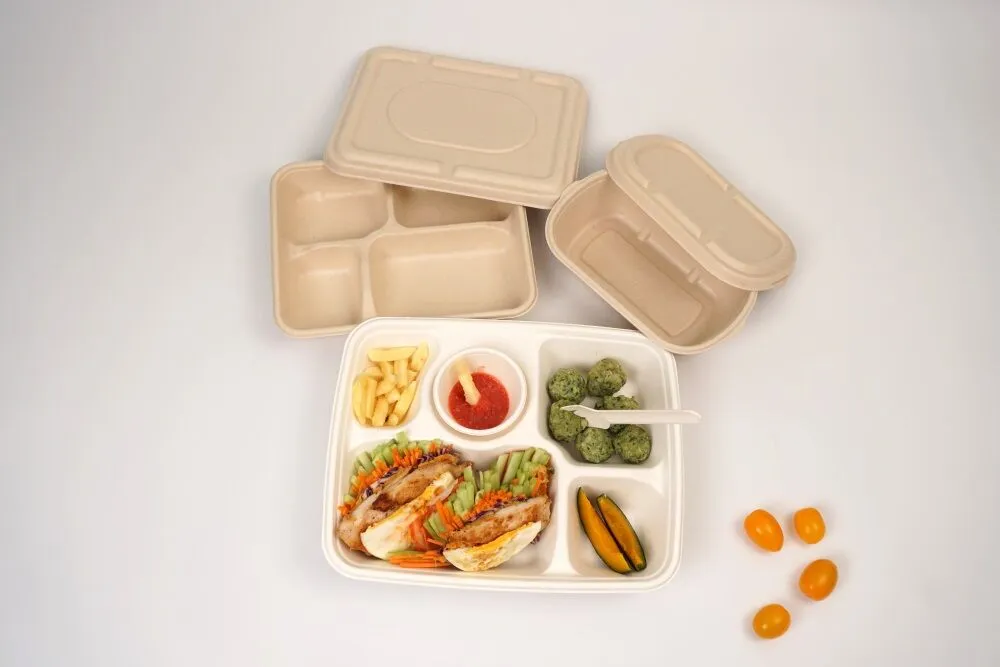
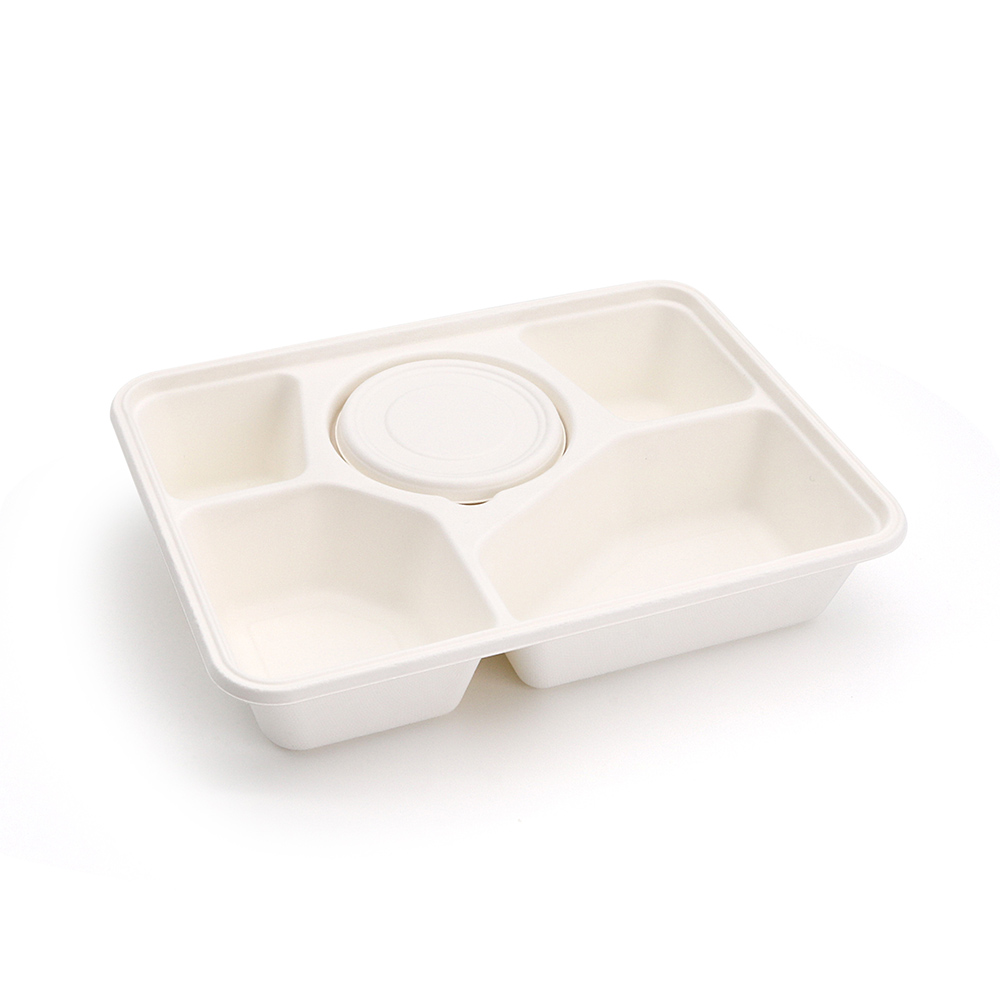
Catering companies, bento meal providers, and meal prep businesses require precise food separation. Multi-compartment lunch boxes prevent the mixing of different ingredients, ensuring that wet sauces do not compromise dry side dishes. Whether utilizing a 2-compartment, 3-compartment, or highly segmented tray, corn starch packaging offers rigid internal dividers that improve food presentation and maintain the culinary integrity of complex ready-to-eat foods and corporate cafeteria meals.
4. Assess Branding Value and Customer Perception
Packaging is the most tangible touchpoint a consumer has with a food delivery brand. It serves as a direct reflection of the company’s corporate values and commitment to quality.
Adopting biodegradable lunch boxes allows restaurants and catering companies to actively support sustainable brand positioning, meeting the growing consumer demand for eco-friendly packaging while avoiding the negative stigma increasingly associated with plastic waste.
Meeting Sustainability Expectations
Modern consumers are highly educated regarding environmental issues. When a customer receives a meal in a heavy, single-use plastic container, it often triggers a negative brand association. Conversely, utilizing sustainable takeaway containers demonstrates corporate responsibility. Food delivery platforms and restaurant chains that transition to plant-based materials directly address these consumer sustainability expectations, transforming their packaging from a mere functional necessity into a powerful marketing asset that drives customer loyalty.
Environmental Upgrades Without Sacrificing Performance
The primary concern for procurement managers is whether adopting eco-friendly packaging will compromise the user experience. The transition to corn starch lunch boxes must be framed as a performance upgrade, not a functional sacrifice. By maintaining strict food protection performance—including hot and cold compatibility alongside robust oil and water resistance—businesses assure their clients that they are receiving superior, plastic-free food packaging options without experiencing leaks or deformed containers.
5. Leverage OEM Customization for Brand Identity
Generic, off-the-shelf packaging fails to differentiate a brand in a saturated food delivery market. To build a recognizable identity, food businesses must tailor their packaging to their specific menu and marketing strategy.
A qualified packaging supplier provides comprehensive OEM customization, including specific volumetric sizing, custom compartment designs, and private label logo integration, allowing businesses to align their sustainable packaging directly with their unique brand identity.
Custom Sizes and Compartment Layouts
Standard container sizes do not always accommodate signature dishes or precise portion control requirements. Growing meal prep and ready-to-eat food businesses often require bespoke solutions. A specialized manufacturer offers custom dimensions and custom compartment designs through proprietary mold development. This allows a brand to dictate the exact layout required to present their food perfectly, ensuring that every meal delivered reflects the precise operational standards of the kitchen.
Logo Customization and Private Label Solutions
For catering companies and expanding restaurant franchises, the physical container is a mobile billboard. OEM customization capability includes logo customization and tailored private label solutions. By embossing brand logos onto the lids of biodegradable lunch boxes or customizing the outer wholesale packaging, businesses significantly enhance their professional presentation and reinforce their sustainable brand positioning with every single order.
6. Balance Long-Term Costs with Stable Wholesale Supply
Procurement decisions based solely on the lowest initial unit price often ignore the catastrophic hidden costs of supply chain disruptions and defective packaging batches.
Partnering with a factory-direct wholesale supplier ensures consistent batch quality, stable bulk production, and reliable delivery, effectively lowering the long-term operational costs associated with packaging defects, food refunds, and supply interruptions.
Factory-Direct Wholesale Advantages
Commercial clients, such as corporate cafeterias and institutional caterers, require massive volumes of packaging delivered on a strict schedule. Relying on trading intermediaries introduces unacceptable risks regarding inventory stability. Sourcing disposable lunch boxes wholesale directly from the manufacturer guarantees a stable supply chain. Factory-direct suppliers maintain the large-scale production capacity necessary to absorb bulk orders seamlessly, ensuring that high-frequency food operations never experience a stockout.
Ensuring Consistent Batch Quality
A minor defect in a food container’s lid seal can result in thousands of dollars in refunded delivery orders. Reliable wholesale compostable food containers for businesses are manufactured under stringent quality control protocols. By evaluating a supplier’s ability to maintain consistent quality across massive production runs, procurement teams mitigate the risk of widespread packaging failures, thereby protecting their profit margins and overall brand reputation.
7. Why Hfenggreen is the Ideal Partner for Biodegradable Solutions
Hfenggreen has engineered its manufacturing ecosystem specifically to solve the cost, performance, and customization challenges faced by global food service enterprises seeking an alternative to plastic.
Hfenggreen manufactures high-performance, non-GMO corn starch lunch boxes featuring advanced oil and water resistance, offering extensive OEM customization and stable factory-direct wholesale supply for global food service businesses.
Comprehensive Product Portfolio
To lower the procurement difficulty for B2B buyers, Hfenggreen provides multiple product options from a single, reliable source. We eliminate the need to manage multiple vendors by offering a wide array of different capacities and structures. Whether a restaurant requires standard single-compartment clamshells for fast food, or a catering company needs heavy-duty 1200ml large-capacity multi-compartment containers for corporate events, Hfenggreen has the exact solution. Our products are rigorously tested for food-contact safety and are fully capable of handling diverse commercial application scenarios.
Scalable Manufacturing and OEM Support
Hfenggreen operates on a factory-direct supply model, ensuring that our clients receive highly competitive wholesale pricing without compromising on material integrity. We actively help brands meet their sustainability requirements by reducing their dependence on plastic. Furthermore, our deep OEM customization capabilities mean we can adjust container specifications, design custom molds, and implement private label branding to match your precise operational needs. Partnering with Hfenggreen guarantees consistent quality, reliable bulk delivery, and a future-proof packaging strategy for your food business.
Conclusion
Choosing between corn starch and plastic lunch boxes requires food businesses to evaluate more than just the upfront cost per unit. While plastic offers historical familiarity, it presents escalating regulatory risks and alienates eco-conscious consumers. By upgrading to high-performance corn starch lunch boxes, restaurants, catering companies, and food delivery platforms secure robust thermal stability, secure leak-proof designs, and verifiable sustainability. Partnering with a capable manufacturer that provides OEM customization and stable wholesale supply ensures that this transition enhances both operational efficiency and brand equity.
Ready to upgrade your food packaging strategy and eliminate plastic waste?
Contact the manufacturing experts at Hfenggreen today to request technical consultation, order product samples for kitchen evaluation, or receive a customized factory-direct quotation for your next bulk order.
FAQ
Are corn starch lunch boxes as durable as traditional plastic containers?
Yes. High-quality corn starch lunch boxes are engineered using advanced plant-based bio-composites that provide robust structural integrity, excellent stacking strength, and secure lid closures, matching the physical durability of conventional plastic food containers.
Can corn starch takeaway containers handle hot, oily, or liquid-heavy foods?
Absolutely. Professional-grade corn starch packaging is specifically formulated to be inherently water-resistant and oil-resistant. It safely accommodates steaming hot meals, deep-fried foods, and heavy sauces without leaking, warping, or becoming soggy.
How do corn starch lunch boxes benefit my restaurant’s brand image?
Modern consumers actively seek out businesses that demonstrate environmental responsibility. Utilizing compostable food containers highlights your commitment to sustainability, meeting customer expectations, reducing plastic waste, and elevating your overall brand perception in a competitive market.
Does Hfenggreen offer custom designs for specific meal prep requirements?
Yes. We provide comprehensive OEM customization capabilities. This includes developing custom compartment designs to separate specific food items, creating custom volumetric sizes, and integrating your private label logo directly onto the packaging.
What sizes and capacities are available for wholesale orders?
Hfenggreen offers a wide range of capacities to suit different business needs, from standard fast-food sizes to large-capacity 1200ml containers ideal for catering companies, family-style takeaway portions, and institutional meal services.
Can you guarantee stable bulk supply for large food delivery platforms?
Yes. Hfenggreen operates as a factory-direct manufacturer with large-scale production capabilities. We guarantee stable bulk supply, consistent batch quality, and reliable delivery schedules to ensure your high-volume food operations never face a packaging shortage.